
China is the ascending power in the world,[1] and with its increased strength it has become a threat to United States (US) power, whether relative or absolute. It has had the most intense increase in Gross Domestic Product (GDP) and influence across the world.[2] It is also a one-party authoritarian state run in a manner reminiscent of organized crime syndicates – behaving, in ways, like a ‘gangster state’ – including incidents of kidnapping,[3] internal strife, corruption[4] and extortion.[5] The Chinese Communist Party (CCP) – perhaps as much fascist as communist[6] – has its hands in all aspects of Chinese society,[7] acting through deception with lies, denials and theft.[8] It controls information, surveils its citizens and disappears its dissidents.[9] This is the nation President Joe Biden describes as a “serious competitor.”[10] How has China gotten to the point of threatening the US and being capable of intimidating its allies in the Indo-Pacific,[11] most notably Taiwan, where is it heading and has the current administration sufficiently addressed China’s ambitions?
Consider the history of some of the most successful industrialized autocracies – Nazi Germany and Imperial Japan. Their collapses are partly attributed to expanding too far, too quickly, embroiling too many in opposition, exposing themselves by spreading their forces too broadly.[12] Though the CCP has largely cleansed China of its own history,[13] its leaders do not remain ignorant to world history, most certainly not of its own 20th century conflict with a militant Japan. And the lessons learned from these imperialist nations – both were successful in acquiring regional power through domestic policy that emphasized production, resulting in strength that could be applied outwardly – appeared to have been applied.
Its leaders have adopted similar statist, oppressive, and racist policies[14] for the betterment of the state, allowing a degree of capitalism, albeit under the control of the CCP.[15] Further, there are signs it has fused the worst aspects of the 20th century’s other leading socio-economic systems – capitalism’s exploitative mercantilism with communism’s suppression of freedom. From an economic standpoint, it has clearly worked. China’s GDP is projected to roughly double over the next decade.[16]

The deliberate pace of their territorial expansion, once limited to such matters as the treaty-based assumption of Hong Kong and a quiet buildup of military bases in the south China Sea,[17] may very well be an effort to avoid the failing of rapid territorial expansionism, which would be consistent with the CCP’s long-term strategy to displace the US as the world’s leader.[18] Still, some behavior mimics the same early stages of fascism that led to the deaths of millions in the first half of the 20th Century.
And over the last two (2) years, China has been flexing its muscles even more in the region with its approaches toward India[19] and Pacific nations.[20]
Free peoples, particularly the leaders in the democratic nations with whom Biden professes to align himself, would do well to ask themselves, ‘what is the difference between the pre-war 20th century fascism of Germany or Japan and the current 21st century communism of China?’ Is a reluctance to acknowledge the replication due to the lack of a world war and the millions that perished through genocide and military aggression? Must one wait for that? Might that underway in some fashion?
An indelible quality of the Nazi regime was its antisemitism, and though that was an early part of the propaganda, incorporated into its rhetoric from the Nazi party’s founding in 1920, its greatest and most well-known atrocity – the organized mass murder that was “Final Solution” – did not occur until the waning years of Adolph Hitler’s reign, two (2) decades later. But the offences against the Jews – as well as other minorities – slowly accelerated when Hitler assumed the title of Fuhrer – leader – in 1934, most famously evidenced by Kristallnacht, in which thousands of Jewish-owned businesses were damaged and destroyed. Genocide did not occur suddenly, nor immediately. It was preceded by condemnation, followed by persecution, then separation, then concentration camps,[21] escalating as the state grew more powerful.
If these are precursors to large-scale destruction – whether through war or genocide – and the gauge by which one measures extreme authoritarian threats, the current imprisonment and forced labor of Uyghurs in China’s ‘reeducation camps’[22] should not be so casually dismissed. Are they not reminiscent of the early stages of the Holocaust, the Jewish ghettos in Germany, a state-sponsored separation of a minority race to protect the alleged ‘purity’ of the preferred ethnic majority?
And what will be said should the origin of COVID-19 be proven the Wuhan Lab in China,[23] particularly if manufactured? Millions will have been killed.[24] If the virus was the result of anything more than carelessness, that could prove to be an act of indiscriminate war in itself.
Amidst these questions, the statist nation hosted the 2022 Winter Olympics,[25] reminding many of the 1936 Berlin Olympics, a Nazi propaganda display that preceded the terror they unleashed with World War II.[26] European nations’ discussions of boycott in 1936 proved fruitless. Did the world take a stand against China in this year’s games? The West responded with a diplomatic boycott described as little more than symbolic and insignificant.[27] (Albeit toothless, the motion against China was more than Western nations did with Germany’s games.[28])
When reading the history of fascist Germany, a common question arises, ‘what would you have done in the moment, in the face of tyranny?’ This is but a hypothetical reflection of history where there is nothing to lose when presenting yourself a defender of freedom. If the CCP’s China is tracking with history, this question becomes critical and real today. There is opportunity to make that call in the moment, only now it is without the benefit and safe comfort of foreknowledge that allow so easily for one to side with the victor. History has not fared well for those soft in the face of tyranny, particularly its collaborators.
Who is siding with the CCP today, and why? If it is a legitimate threat to liberty worldwide, who is standing against its China?
There Is No Time to Be a Lamb Before the Tiger
With the presidency of Donald Trump, foreign policy toward China took a more assertive tone than previous administrations. Although often speaking of China’s President Xi Jinping in favorable terms publicly,[29] his actions included protective tariffs against Chinese imports[30] unseen in decades. Indeed, Trump campaigned on his long-held belief that the US had allowed China to take advantage of the West’s – particularly the US’s – economic policy,[31] a position that was largely dismissed by the establishment, which favored greater economic integration with China. His America First policy included a focus on bringing jobs home,[32] decreasing reliance on nations like China.[33]
In the wake of the COVID-19 pandemic, and the supply chain issues that highlight the faults of relying on other nations for essential supplies like personal protective equipment (PPE) and pharmaceuticals, this element of Trump’s policy has gained traction, even influencing his staunch opponent’s – President Biden’s – views toward China[34] and the Build Back Better (BBB) philosophy,[35] which emphasizes American industrialism.
However, the desire to build manufacturing jobs domestically does not mean there is a substantive change toward China, only that it would benefit Americans to increase domestic production, which few would argue against. Has anything changed within Biden, who was largely entrusted with the America’s foreign policy toward China during the Barrack Obama administration? In 2019, only days after announcing his candidacy for president, he dismissed the China threat, mocking the concern that China would ‘eat our lunch,’ declaring them ‘not bad folks.’[36] These ‘folks’ have been pressing with a multitude of aggressive maneuvers taking advantage of the West’s policies and self-indulgent nature with a ‘China First’ strategy.
Beyond industry and traditional economics, it banned crypto trading and mining[37] while developing a domestic crypto currency for what may be part of an effort to replace the US dollar as the world’s reserve currency.[38] If successful, that would grant them extensive control of both energy and financing, and with that, an incredible ability to manipulate the world’s economy.
As the world’s greatest emissions polluter,[39] it continues to build coal plants[40] in a push for greater energy dominance, a clear dismissal of the West’s climate change concerns, whilst hording the minerals required for the batteries used to power the electric vehicles[41] prioritized by the West’s internal energy policies, policies aimed to reduce its own emissions in effort to combat the climate change that is worsened by China’s own energy policy.
Its leaders are exploiting the cooperative nature of the United Nations (UN) and its reliance on the rule of law to undercut democracies, claiming influence in the halls of power, affecting governments’ policy[42] as nations become more beholden to China, possibly even providing a list of dissidents that would enable the CCP to pressure families.[43]
In the crucial early days of the global pandemic, one which is broadly believed to have originated in Wuhan,[44] the Chinese-supported leader of the World Health Organization (WHO) dismissed concerns that connected COVID-19 to China.[45]
Already hosting an active-duty troop size that nearly doubles the US’s, it has more recently surpassed its rival in fielding the world’s largest navy.[46] The Chinese military even constructed life-size mockups of US warships for wargames,[47] signaling to the world who it views at its next naval combatant.
Fentanyl originating from China[48] has claimed the lives of tens of thousands of Americans,[49] disrupting hundreds of thousands more and undermining communities across the country.
Their outspoken efforts to replace the US as the world’s top economy has been strategically supplemented by their policy of “elite capture,” an effort to influence foreign leaders through money, access, opportunity and favors.[50] Meanwhile, a Delaware attorney is investigating the president’s own son, Hunter Biden,[51] who had curiously lucrative deals with Chinese officials[52] – including those with ties to the CCP security apparatus – for which the president has long denied any knowledge,[53] despite having brought him to China on the US’s Air Force Two as vice president.[54] (The Secret Service suggests it cannot find the younger Biden’s travel records.[55])
So where does foreign policy toward China land under a President Biden?
Less than two (2) years after Biden’s dismissive words about Chinese ‘folks,’ when convenient in pursuit of his domestic infrastructure goals, he declared the opposite, that China would ‘eat our lunch.’[56] But change requires more than words. Actions have the greater impact. Words are possibilities, actions are realities. And as the world has learned, most notably with the withdrawal from Afghanistan, Biden’s words are not always consistent with his actions. What has he done?
Despite evidence and pending indictments brought against Chinese citizens in the US for theft of intellectual property (IP), the Biden administration moved to dismantle bipartisan anti-espionage prosecutions authorized by Trump’s China Initiative, canceling the Department of Justice’s (DOJ) investigations.[57]
The president, who had suggested the world was aligning against tyranny,[58] indicated early that he was not going to confront China in more meaningful manner on matters that impacted freedoms within China – whether that was the ongoing genocide of the Uyghurs, which he dismissed as ‘different norms,’[59] or the slow erosion of rights in Hong Kong, which he has, at least, condemned[60] – or amongst the peoples of the world – whether found in the advances in the Indo-Pacific or the origins of a virus that resulted in the deaths of millions of innocents across the world. Instead, the administration has often publicly deferred to the Chinese position that foreign nations should not comment on the internal affairs of another. (His progressive allies have even gone so far as to request Biden remain silent on human rights abuses out of fear that it will impact their greater climate change goals,[61] a problematic confluence of the administration’s professed foreign affairs priorities – climate change and defending democratic freedoms.)
Rather than stress these concerns in the US’s first meeting with China in Alaska, Biden’s Secretary of State, Antony Blinken, listened to Chinese officials lecture him on America’s race relations,[62] for which he made little defense against accusations of human rights abuses, and instruct the US to stop promoting democracy. Then, when the Secretary later posts support for the people of Hong Kong, the State Department promptly removed it.[63]
And, if initial reports about his meeting with Xi are correct, Biden refused to acknowledge the elephant in the room, to raise the issue of the coronavirus’ origin and a proper investigation. Considering China’s response to Australia’s questioning of the virus – one which included the CCP mouthpiece, China Global Times, argue for consideration of bombing Australia[64] – it is unsurprising that a president, Biden, who has long preferred diplomacy, would do anything necessary to reduce tensions. (Note: nearly a year later, Biden denied reports that he did not raise the virus’ origin with Xi,[65] a curiously belated claim.)
When Microsoft Exchange servers were hit with a cyberattack, Biden called it out but did nothing in the form of sanctions,[66] not so dissimilar to his response to Russia’s cyberattack on Colonial Pipeline.[67]
While securing the release of an improperly retained US citizen ahead of his call with Xi, the president released seven (7) Chinese convicted criminals.[68] His DOJ dropped the cases against Chinese researchers – alleged spies – accused of visa fraud.[69]
What explains this general approach if not a desire to maximize non-confrontation? But why avoid confrontation? Confrontation is not inherently destructive. It can be productive, resolve matters, defuse tensions. Failure to take a meaningful stand against aggressions can embolden aggressors, yielding the worst of results.
Such failure reinforced the belief of that 20th Century’s most infamous tyrant – Hitler – that he could continue imposing his will on his neighbors without much reprisal. War has yet to break out in the South Pacific, but Western reluctance to respond to China’s growing military strength is reminiscent of its reluctance to respond to the Nazi’s violations of the 1919 Treaty of Versailles, which legally forbade Germany from developing an offensive military.[70] Well before war erupted in Europe, Hitler revealed the results of his programs to the world with a display of new German military strength. The US and European nations said little and did next to nothing, which surprised Nazi leaders, which no doubt encouraged them.[71]
And with this knowledge of the past, there is a potentially imminent Taiwan crisis on the horizon.
The Most Difficult of Decisions Are Ahead
With the administration’s consistent signals of conflict avoidance, and the actual conflict avoided by withdrawing US soldiers from Afghanistan in August 2021, leaving it to a terrorist organization[72] – the Taliban – China proceeded to send 56 fighter jets into Taiwanese airspace,[73] a clear intimidation effort that has been followed with a ramp-up of flyovers.[74]
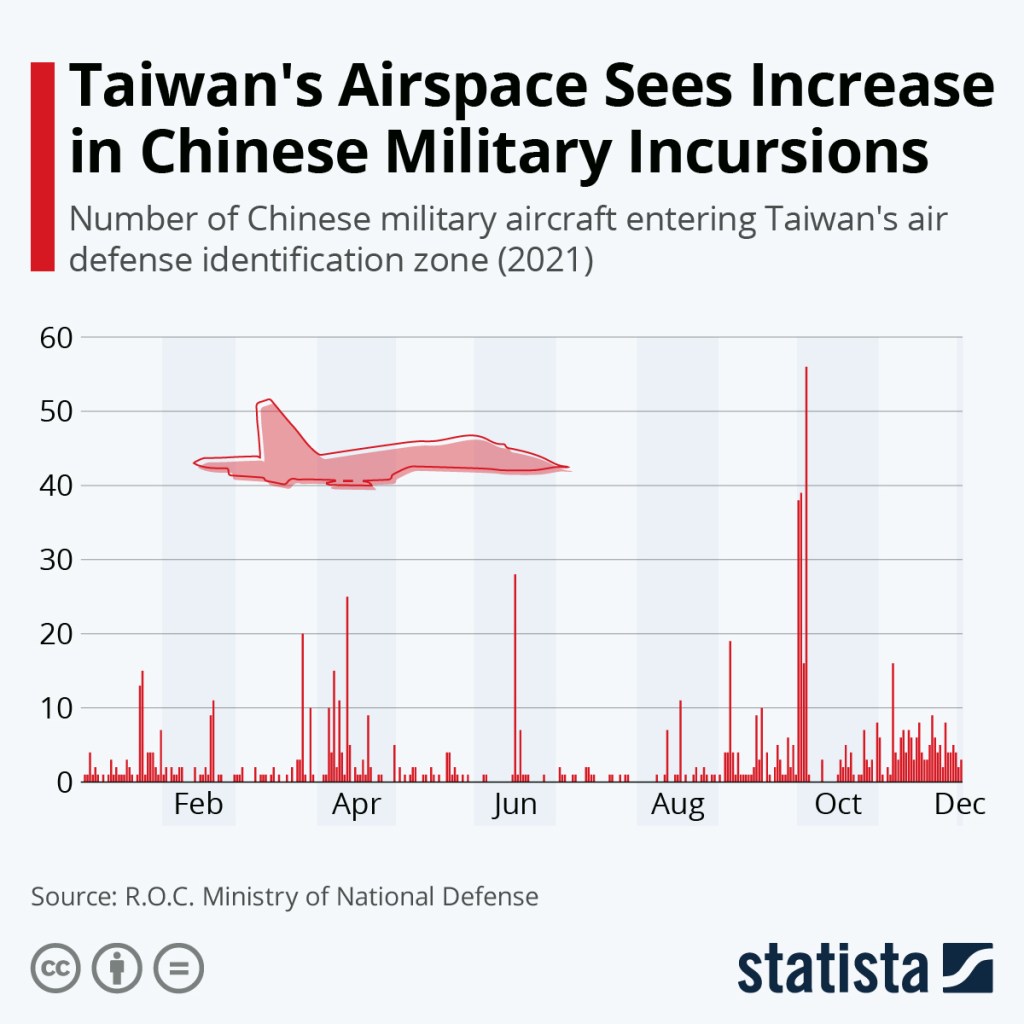
With Russia resting on the edge of invading Ukraine and the West refusing to supply troops, China threatens war with Taiwan, an effort that would aim to complete its long-term goal of ‘reunification.’[75]
Despite, if not because of, the open claims and signals coming from Xi, the Biden administration has reached out to Taiwan with offers of cooperation, military training and armament[76] – an effort to boost support and morale – and increased the presence of US military personnel stationed there.[77] How far will the administration’s efforts go to prevent the takeover of the democratic nation of Taiwan?
Will maximum conflict avoidance produce success in Biden’s Asia policy or does it simply signal a greater tolerance for bad actions? Does the increase in provocative behavior from China and North Korea suggest it is working? What will the president do in response to Federal Bureau of Investigation (FBI) Director Christopher Wray’s recent warning of the increased threat of Chinese cyberattacks?[78]
Will the president work to establish a bulwark by strengthening its alliances with the free Pacific nations like Japan, South Korea and Australia? With India neighboring America’s two (2) greatest adversaries – China and Russia – and claiming one of the world’s largest armies,[79] will Biden have the foresight to recognize the critical role India would play as a strategic partner in the event of conflict and endeavor to strengthen US relations there, disrupting Russian efforts to do the same? His meeting with the Quadrilateral Security Dialogue (QSD, or QUAD) may serve as evidence that the administration understands these needs, but to what degree will he move to strengthen critical alliances and secure peace when stressing the meeting is but an ‘unofficial gathering’? [80] In late 2021, the Central Intelligence Agency (CIA) announced a new effort to counter the Chinese threat with the establishment of the China Mission Center.[81] Time will tell where that leads.
Meanwhile, China has engaged with its partners, Russia[82] and Iran,[83] in forming what are eerily reminiscent of the Axis agreement between Germany, Italy and Japan in the years that preceded World War II. With Russia, there are indications that China is working to divvy up the world in spheres of influence, believing their autocracies the way of the future. With Iran, a 25-year deal has been reached that could provide the Middle East’s state sponsor of terror with enriched uranium, a critical component to its nuclear ambitions.
Is war imminent? Is the US prepared? Will it meet the moment?
While China has been building up its military both in size and technical capacity, the US, under former president Barrack Obama, cut the military modernization budget,[84] an effort that may have granted China the ability to catch up, if not exceed, US capabilities. Under Biden’s 2021 budget, military spending became one of the few areas that was not adjusted sufficiently to keep pace with the economy, shrinking relative to inflation.[85] The US continues to vastly outspend China on its military, but the latter is seeing relative gains, and it is on pace to exceed US expenditures in about 20 – 25 years.
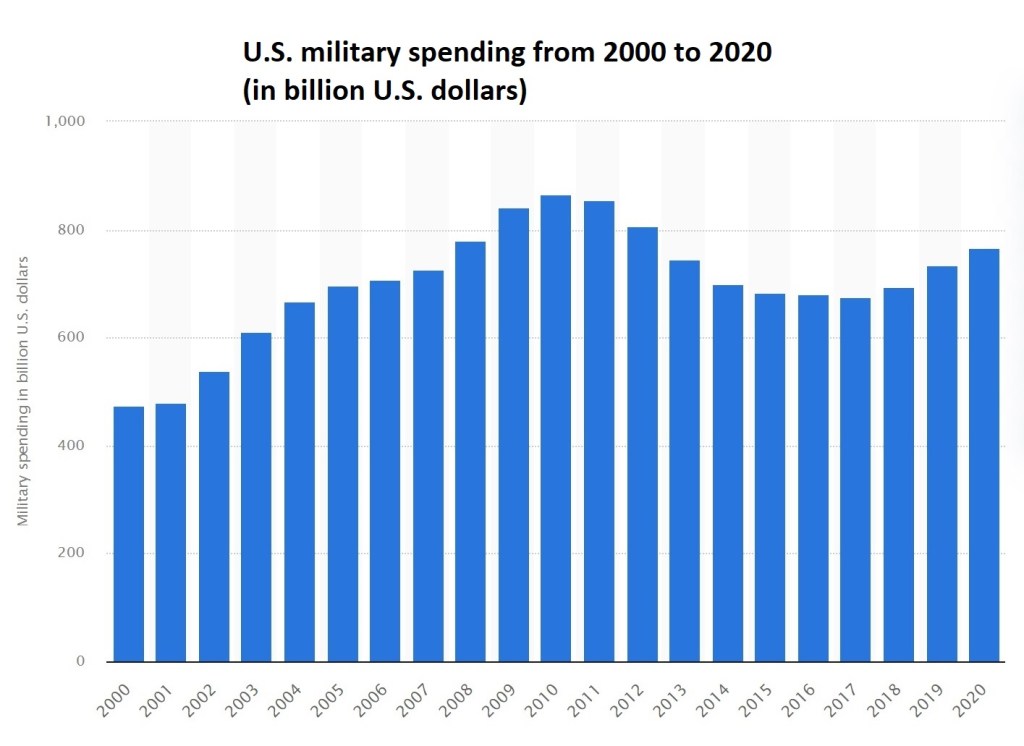

While China designing a military capable of defeating the US in combat, the US is instructing its soldiers on social theories[86] and dismissing them from service for refusal to get vaccinated[87] (against a virus that came from China).
In response to the building of airbases in the South China Sea, the US could rebuild and strengthen its airbases in Australia and Guam. Rather than continue with policies that react to crises, Biden could prepare to defend Taiwan with a more notable naval presence. It has not.
With China increasingly open in its anti-Americanism, is it time for the US to be openly anti-China? Perhaps not, but upper-level efforts to contain the spreading influence of the CCP’s freedom-crushing influences have been wanting.
On its own, the CCP has made the strategic decision to partner with a fledgling Russia – a state trying to cling onto its status as a world power. It has opted to align with the world’s notorious violators of human rights like Iran, signaling to the free nations what it values. It has begun to increase China’s involvement in Afghanistan, the “Graveyard of Empires.”[88] Although CCP leaders will only allow China to remain tied to these nations so long as the agreements and relationships prove beneficial to their own nation’s goals, it is quite possible China’s leaders are slowly setting its nation up for collapse.
But that does not mean the US should simply stand by and wait. What will the US do to discourage China’s continued military buildup and increased aggression? Will the current administration take formative action to strengthen ties with Indo-Pacific allies and box out China’s influence to the degree possible? Will the president stand up to the CCP? Can the West meet the moment?
[1] China’s Growing Global Influence: What’s at Stake? (U.S. Global Leadership Coalition)
[2] Hal Brands, America’s War for Global Order Is a Marathon, (Foreign Policy, 2022)
[3] Tom Phillips, China behaving like ‘gangster’ state with bookseller kidnap, say Hong Kong politicians, (The Guardian, 2016)
[4] Lily Kuo, China’s Xi Jinping facing widespread opposition in his own party, insider claims, (The Guardian, 2020)
[5] Gordon G. Chang, Apple Makes ‘Essentially Extortion’ Payment to China, (Newsweek, 2021)
[6] Michael A. Ledeen, From Communism to Fascism? (Wall Street Journal, 2002)
[7] Eleanor Albert, Lindsay Maizland and Beina Xu, The Chinese Communist Party, (Council on Foreign Relations, 2021)
[8] China still steals commercial secrets for its own firms’ profit, (The Economist, 2021)
[9] EXPLAINER: What drives high-profile disappearances in China, (AP News, 2021)
[10] Orion Rummler, Biden calls Russia an “opponent,” sees China as a “serious competitor”, (Axios, 2020)
[11] China’s Military Aggression in the Indo-Pacific Region, (US Department of State, 2020)
[12] Richard Rosecrance, Overextension, Vulnerability, and Conflict: The “Goldilocks Problem” in International Strategy (A Review Essay), (International Security, Vol. 19, No 4, 1995)
[13] Alice Su, He tried to commemorate erased history. China detained him, then erased that too, (Los Angeles Times, 2021)
[14] Who are the Uyghurs and why is China being accused of genocide? (BBC News, 2021)
[15] Scott Kennedy and Jude Blanchette, Chinese State Capitalism, (Center for Strategic and International Studies, 2021)
[16] Gross domestic product (GDP) at current prices in China from 1985 to 2021 with forecasts until 2027, (Statista, 2022)
[17] China’s South China Sea Military Bases Are a Total Paper Tiger, (The National Interest, 2021)
[18] Rush Doshi, The long game, (Brookings, 2021)
[19] Sushant Singh, Why China Is Winning Against India, (Foreign Policy, 2021)
[20] Jonathan Pryke, The risks of China’s ambitions in the South Pacific, (Brookings, 2020)
[21] Haaretz, When Did the Holocaust Begin? A Genesis of Genocide, (Haaretz, 2020)
[22] Lindsay Maizland, China’s Repression of Uyghurs in Xinjiang, (Council on Foreign Relations, 2021)
[23] Sasha Pezenik, Scientists demand new investigation of COVID-19 origins ahead of Beijing Olympics, (ABC News, 2022)
[24] David Adam, The pandemic’s true death toll: millions more than official counts, (Nature, 2022)
[25] Ben Blanchard, Beijing rolls out the propaganda to welcome Games, (Reuters, 2022)
[26] Learn about the 1936 Berlin Olympic Games a showcase for Hitler’s Reich with its technological prowess, (Britannica)
[27] Beijing Winter Olympics boycott is insignificant, says Macron, (BBC, 2021)
[28] Editors, Berlin 1936 Olympic Games, (Britannica)
[29] David Shepardson, Trump praises Chinese president extending tenure ‘for life’, (Reuters, 2018)
[30] Staff, Timeline: Key dates in the U.S.-China trade war, (Reuters, 2020)
[31] Trump accuses China of ‘raping’ US with unfair trade policy, (BBC News, 2016)
[32] Ryan Teague Beckwith, Read Donald Trump’s ‘America First’ Foreign Policy Speech, (2016)
[33] Naomi Xu Elegant, Trump wants to end U.S. reliance on Chinese manufacturing ‘once and for all.’ U.S. firms aren’t complying, (Fortune, 2020)
[34] Jodi Xu Klein, He Huifeng and Su-Lin Tan, Biden push to reduce US dependence on foreign suppliers in key sectors ‘faces many hurdles’, (South China Morning Post, 2021)
[35] Steve Berglund, Manufacturing is integral to Biden’s build back better plan, (The Hill, 2021)
[36] Adam Edelman, Biden’s comments downplaying China threat to U.S. fire up pols on both sides, (NBC News, 2019)
[37] Alun John, Samuel Shen and Tom Wilson, China’s top regulators ban crypto trading and mining, sending bitcoin tumbling, (Reuters, 2021)
[38] Charlie Campbell, How China’s Digital Currency Could Challenge the Almighty Dollar, (Time, 2021)
[39] Ian Tiseo, Largest global emitters of carbon dioxide by country 2020, (Statista, 2021)
[40] Amy Gunia, China Is Planning to Build 43 New Coal-Fired Power Plants. Can It Still Keep Its Promises to Cut Emissions? (Time, 2021)
[41] Camila Domonoske, How China dominates the electric vehicle supply chain, (NPR, 2022)
[42] Michael Schuman, China Wants to Rule the World by Controlling the Rules, (The Atlantic, 2021)
[43] Henry Samuel, UN shared names of Chinese dissidents with Beijing, says sacked whistleblower, (The Telegraph, 2021)
[44] Umair Irfan, We have the best view yet of Covid-19’s origins. What should we do about it? (Vox, 2022)
[45] Kathy Gilsinan, How China Deceived the WHO, (The Atlantic, 2020)
[46] Shaun Yuan, Just how strong is the Chinese Military? (Al Jazeera, 2021)
[47] Satellite images show China built mock-ups of US warships, (AP News, 2021)
[48] Vanda Felbab-Brown, China and synthetic drugs control: Fentanyl, methamphetamines, and precursors, (Brookings, 2022)
[49] Fentanyl Abuse Statistics, (National Center for Drug Abuse Statistics)
[50] Schweizer, Peter, Elite Capture, (Gatestone Institute, 2022)
[51] Alexander Mallin, Aaron Katersky and Lucien Bruggeman, Federal probe into Hunter Biden’s taxes intensifies, sources say, (ABC News, 2022)
[52] Matt Viser, Tom Hamburger and Craig Timberg, Inside Hunter Biden’s multimillion-dollar deals with a Chinese energy company, (The Washington Post, 2022)
[53] Aamer Madhani, Biden: I never talked to son Hunter about overseas business dealings, (USA Today, 2019)
[54] Josh Lederman, Biden’s trip to China with son Hunter in 2013 comes under new scrutiny, (NBC News, 2019)
[55] Jerry Dunleavy, Secret Service says it can’t find Hunter Biden travel records for 2010, 2011, or 2013, (The Washington Examiner, 2022)
[56] Amanda Macias, Biden warns China is going to ‘eat our lunch’ if U.S. doesn’t get moving on infrastructure, (CNBC, 2021)
[57] Ryan Lucas, The Justice Department is ending its controversial China Initiative, (NPR, 2022)
[58] Editor, High on Luster, Shy on Muster: The Biden Doctrine and a World on the Brink, (The Offence, 2022)
[59] Emily Jacobs, Biden dismisses Uighur genocide as part of China’s ‘different norms’ (New York Post, 2021)
[60] Staff, Biden says U.S. should lead world in condemning China over Hong Kong actions, (Reuters, 2020)
[61] Emily Jacobs, Progressives tell Biden to ignore China abuses for climate change, (New York Post, 2021)
[62] US and China trade angry words at high-level Alaska talks, (BBC News, 2021)
[63] Darragh Roche, Antony Blinken Deletes Tweet Saying “We Stand With the People of Hong Kong’, (Newsweek, 2021)
[64] Josh Dutton, ‘Retaliatory punishment’: Chinese paper calls for strike on ‘Australian soil’, (Yahoo! News, 2021)
[65] Steven Nelson, Biden insists he pressed China’s Xi on COVID origin – but aids weren’t in the room, (New York Post, 2022)
[66] Sean Keane, Biden administration blames China for Microsoft Exchange email hack, (CNET, 2021)
[67] Biden Says Russia Has ‘Some Responsibility’ In Pipeline Ransomware Attack, (Radio Free Europe Radio Liberty, 2021)
[68] Michael Martina, EXCLUSIVE American barred from leaving China returned to U.S. before Biden-Xi meeting, (Reuters, 2021)
[69] Celine Castronuovo, DOJ drops charges against five visiting researchers from China, (The Hill, 2021)
[70] Editors, Treaty of Versailles, (Britannica)
[71] Carlin, David, World War II: How Western Leaders Failed to Stop the Nazi Rise (Forbes, 2019)
[72] George Packer, Joe Biden’s Saigon, (The Atlantic, 2022)
[73] Eric Cheung, China sent 56 warplanes into Taiwan defense zone on Monday, Taipei says, (CNN, 2021)
[74] Taiwan warns Chinese aircraft in its air defence zone, (Reuters, 2022)
[75] China warns Taiwan Independence ‘means war’ as US pledges support, (BBC News, 2021)
[76] Derek Grossman, Biden Administration Shows Unwavering Support for Taiwan, (Rand Corporation, 2021)
[77] Erin Hale, US Nearly Doubled Military Personnel Stationed in Taiwan This Year, (VOA, 2021)
[78] Quinn Klinefelter, Russia may launch cyberattacks against businesses, critical infrastructure, FBI director warns, (WDET, 2022)
[79] Sushmita Choudhury, How India has the world’s 4th best military, (Times of India, 2022)
[80] Nikki Carvajal, Biden officials stress Quad is an ‘unofficial gathering,’ ‘not a military alliance,’ ahead of first in-person meeting, (CNN, 2021)
[81] Quint Forget and Daniel Lippman, CIA launches new China-focused unit, (Politico, 2021)
[82] Zaheena Rasheed, Why are China and Russia strengthening ties? (Al Jazeera, 2021)
[83] Farnaz Fassihi and Steven Lee Myers, China, With $400 Billion Iran Deal, Could Deepen Influence in Mideast, (The New York Times, 2021)
[84] Baker Spring, Obama’s Defense Budget Makes Protecting America its Lowest Priority, (The Heritage Foundation, 2012)
[85] Thomas Spoehr, Biden’s First Defense Budget Batters the Army, (The Heritage Foundation, 2021)
[86] Sarah Betancourt, America’s top general defends study of critical race theory by military, (The Guardian, 2021)
[87] Avie Schneider, U.S. Army begins to discharge soldiers who refuse COVID-19 vaccinations, (NPR, 2022)
[88] Akhilesh Pillalamarri, Why is Afghanistan the ‘Graveyard of Empires’? (The Diplomat, 2017)
 The Offence