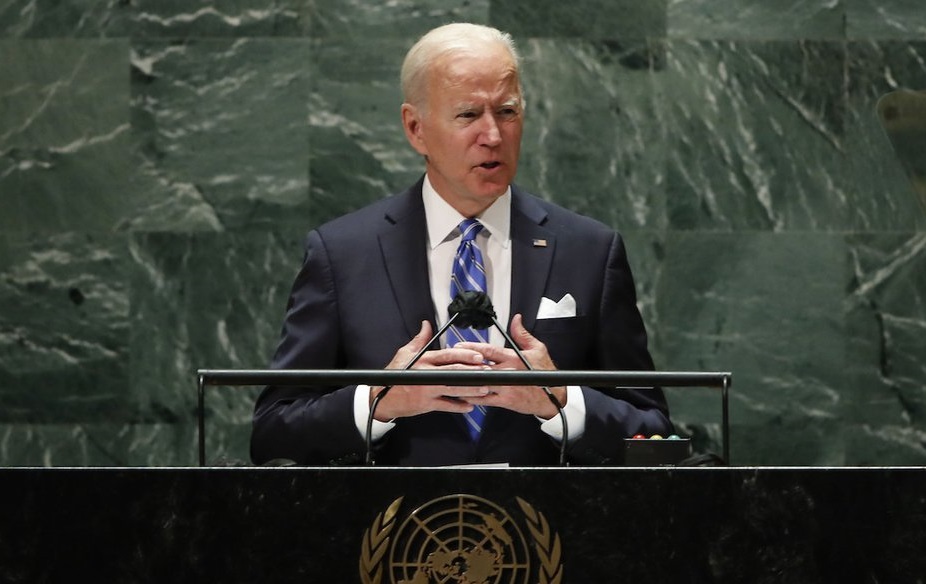
Receiving little attention in one of Joe Biden’s first speeches as president was the framing of his foreign policy. Some highlighted its emphasis on cooperation in matters like climate change, leaving critics to question how that would be the focus when there were more immediate threats rising in the world ranging from international terrorism to malicious state actors. Providing some insight into his worldview, however, he called attention to the “growing ambitions of China…and the determination of Russia to damage and disrupt our democracy.” More broadly, Biden identified a critical component that is beginning to come into view, albeit not on the president’s own terms. He distinguished two (2) diverging forces on the geopolitical scene – “advancing authoritarianism” and “democratic values” – further suggesting his administration would lead to “rally the nations of the world to defend democracy globally, to push back the authoritarianism’s advance.”[1]
Stressing climate change, which he has described as an “essential element” of his foreign policy,[2] and democracy may prove the defining features of the Biden Doctrine, but only in the context of his approach. And whereas the former, by nature of its global impact, necessitates cooperation between nations, the latter tacitly acknowledges a degree of unavoidable conflict between nations. The question remains how best to address conflict and mitigate the consequences.
The Clash of Civilizations
In response to the post-Cold War growing belief that great wars had come to be a measure of the past, as popularized by political scientist, Francis Fukuyama,[3] his colleague, Samuel Huntington, proposed that conflict was likely to arise again along cultural lines that form informal borders around the middle east, eastern Europe and/or southeast Asia. This was his “Clash of Civilizations.”[4] The cultures within these borders are governed by more authoritarian societies. Would their incompatibility with Western democratic values lead to wars as if fault lines given to eventual earthquakes?
An alignment of political systems has been years in the making and should be quite predictable given the history of foreign affairs, particularly if viewing them from Huntington’s perspective.
During the Cold War, the US engaged in strategic wars across the world, commonly in effort to repel authoritarianism, as was the case in Korea and Vietnam in attempt to thwart the advance of communism supported by the Soviet Union.[5],[6] In recent decades, the US entered Afghanistan and Iraq, an effort to quell the forces of international terrorism perpetrated by Islamic fundamentalists.[7] These wars were greatly localized. If not restrained to a nation, they were regional.
It has not been since World War II that war has gone global, embroiling nations across continents, witnessing an alignment of three (3) of the world’s most aggressive and powerful authoritarian nations – the Axis powers of Germany, Italy and Japan[8] – advance against the world’s more democratic nations – primarily, the Allied powers of Europe and the US. Even before America entered the war, President Franklin D. Roosevelt (FDR) proclaimed the US “must be the great arsenal of democracy.”[9] (Although the Soviet Union was clearly authoritarian, it was not until after Germany’s push into Western Europe that it invaded the Soviet Union.[10] Only then, was Joseph Stalin forced to defend his nation against the German incursions, allying with the West.)
There are real questions here. Is the rise of authoritarianism in the face of democratic values inevitable? Would they align so closely once again? Is conflict avoidable?
If history is cyclical, it would suggest this is a natural struggle between – and within – societies. Even America’s own history reflects this. Its greatest domestic wars can be most broadly assessed as conflicts over the right to be free – self-rule with the Revolution,[11] ending slavery with the Civil War.[12] These events were separated by about 75 years. Approximately 75 years later, with the world more interconnected, as evidenced by the effect the 1929 Wall Street stock market crash had on the European economy,[13] conflict went global with the invasion of Poland and the beginning of World War II.[14] The war resulted in the defeat of Axis fascism and increased freedom throughout the world.
Perhaps the values and issues that drive these ideological systems of governance simply take time to percolate. If that is the case, the actions of key international actors would indicate they are percolating today (about 75 years since the end of that world war). Whether predictably cyclical or not, the world is beginning to recognize the rising influence of authoritarianism,[15] if not irresponsibly late, well behind the warning signs, those creeping advancements.
In view of this, where does Biden’s foreign policy lead? Do the president’s actions support his words? How far is he willing to go to defend the free against tyranny? What will America’s enemies glean from his actions, both domestic and foreign, as with his first major international action, the much-criticized withdrawal from Afghanistan?[16],[17]
In the wake of the withdrawal, with allied nations still reeling,[18] though calling for the defense of democracy, the president took the opportunity before the United Nations (UN) to focus on climate change, paying little attention to the more immediate matter on the minds of leaders, something received by many as tone-deaf, referring to a need for “relentless diplomacy.”[19] But what more was the president to say if he was not willing to do?
Months earlier, he had assured European leaders of international cooperation, but he had just executed a unilateral and chaotic withdrawal of US troops from a democratic nation without providing advanced notice to allies, beginning with the abandonment of the critical and strategically-located Bagram Airbase.[20] He promised retaliation[21] for the ISIS suicide bombing that killed 13 US service members guarding Hamid Karzai International Airport in Kabul,[22] yet his sole military response consisted of ordering a “righteous strike” that killed an innocent aid worker and seven (7) children,[23] no confirmed hostiles. He guaranteed the US would stay until all Americans had been safely evacuated,[24] yet knowingly left its civilians and allies behind under the advisement that a fundamentalist authoritarian regime would ultimately – if not quickly – assume power and reverse the civil rights gained by its people.[25]
In his first major international endeavor, his actions fell far short of his words. He was in no position to advocate forcefully for the defense of democracy and freedom, which may be valued by the Biden administration, but actions have signaled that these values run secondary to cooperation on matters such as climate initiatives, as further evidenced by his willingness to sacrifice his nation’s energy independence by restricting the production of domestic fossil fuels.[26] (Greater production leads to cheaper oil, which leads to cheaper gas, which leads to greater use and higher emissions, a leading cause of climate change.[27])
It would be foolish to believe America’s adversaries have failed to take notice of the president’s actions, or that they will not take advantage.
When Idealists Live in the Realists’ World
Perhaps learning from Barrack Obama’s refusal to uphold his red line in Syria respecting the use of chemical weapons,[28] Biden presents few himself. This may be an effort to keep his adversaries guessing, but it also provides the opportunity for them to push the limits without expectation of substantive retaliation, or as in the curiously inexplicable case of providing Vladimir Putin a list of industries that were off-limits when it came to cyberattacks,[29] informally greenlighting attacks elsewhere. After a year, adversaries have yet to discover a true limit. Instead, the US – and the West – continue to permit the preferred politics of idealism to govern decisions on the international landscape, consistently advocating for multilateralism and diplomacy while the world’s realists continue to seek their own national self-interests in increasingly clear and assertive fashion working against democratic values.
Diplomacy and international cooperation certainly have key roles, but the flaw in idealism is that it assumes too much, not just the best intentions of other players, but that others are playing the same game. They are not. If there are any realists in play, the realists set the rules, leaving others but players in an international game of realpolitik. The West may push for harmony as means to achieve broader peace and equity, however defined, but its adversaries’ goals differ, even if they say otherwise. Realists press for their own national interests, and those interests today include diminishing Western power, whether through relative gains or a zero-sum analysis. This is the naïveté and irreconcilable failure of idealism – allies and adversaries are simply not playing the same game.
Consequently, in the way that terrorists have been able to exploit the freedoms granted in the West and sowed fear while wreaking havoc with deadly attacks, nation states can exploit the best intentions of idealists by utilizing their proclivity for short-term gains and non-confrontation as an opportunity to expand economically and territorially. It is not until such times that free nations like the US step up and acknowledge – then play – its adversaries’ game that grand success is achieved, such as bringing an end to the Soviet Union. Until the realists are eliminated from play, the idealists’ goals remain unachievable. Today’s realists – the authoritarian nations the president espouses to oppose – will push until they are halted, possibly only by force. They are, by their nature, led by proverbial strongmen like Vladimir Putin and Xi Jinping.[30] They display, act with and understand strength. This is their language. As do bullies, they will prey upon the weak.
It is something recognized with Donald Trump’s America First policy. With its emphasis on American interests, even questioning allied behavior, such as their failure to live up to financial commitments under the North Atlantic Treaty Organization (NATO),[31] US foreign policy became more realist. It was a disruptive element on the scene,[32] and it clearly unnerved allies that were accustomed to the favorable behavior of American idealism, but it also signaled a different approach to America’s adversaries. It kept them guessing. For other nations, Biden’s election, largely hailed by European leaders,[33] represented a return to ‘normalcy’ – the more practiced style – predictable and concessionary.
But where does that leave the US respecting the authoritarians?
With industrial and financial ties to China only recently seeing a possible move toward decoupling,[34] increasing Europe’s energy dependence on Russia,[35] easing economic sanctions on Iran[36] and leaving military equipment to the Taliban,[37] the politico has taken actions that ultimately fund the West’s enemies to the tune of billions of dollars with the belief that it will prevent aggression.
What evidence is there that this has worked, that they will not turn around and use that to fund their ambitions? Have they ceased advances against democracy or attacks against American institutions? And, it must be said, why provide humanitarian aid to nations with leaders that are diverting resources from its peoples to fund its military ambitions? How is this not but a shell game in which Western nations end up funding the opponents’ armies? Why would leaders who are gaining by virtue of their selfishness and aggression change their behavior? Even if the president’s advisors do not understand this twisted form of positive reinforcement,[38] the bad actors do, and they are acting accordingly. Intentions aside, the more one rewards poor behavior, the more one reinforces poor behavior; the more one reinforces poor behavior, the more poor behavior results. It is basic psychology.
And with the new president preoccupied at home with his effort to fundamentally transform America through welfare expansion,[39] equity programs,[40] the federalization of elections[41] and perhaps demographics by opening the southern border[42] in a manner that allows millions of peoples[43] from across the world[44] to enter freely, America’s enemies are strategically positioned, figuratively and militarily, to transform the world. Somewhat ironically, while promoting democracy and criticizing authoritarianism abroad, Biden’s domestic agenda has consisted of efforts to concentrate power in Washington, a de facto reduction in individual liberties typically assigned to democracies.
Americans, in a nation founded on the revolutionary concept of liberty, are likely to resist this effort, as with the moderate Senate Democrats’ success in stymieing Biden’s progressive legislative priorities,[45] plummeting approval ratings for the president[46] and a party affiliation shift away from his own (Democrats),[47] but can a world resist a simultaneous push of authoritarians on multiple fronts?
In Biden’s first presidential address to a global audience, he declared ‘America is back.’[48] But he also emphasized internal unity in his inauguration address to the US,[49] something he has yet to achieve, if even attempted.[50] Will he prove the uniter abroad he has failed to be at home? The international outcry at the US’s chaotic[51] and unilateral withdrawal from Afghanistan, described by allies as a betrayal and miscalculation that damaged the credibility of the US as a partner,[52] casts serious doubt on this. With his actions in Afghanistan, Biden revealed himself to the world. He will act as he wants, and when he wants. The opinions and interests of others, whether Republicans at home or allied nations abroad, have proven of little concern.
In the end, his efforts may fail to fundamentally transform the country;[53] however, barring the united international strength of free nations, he may succeed in helping to transform the world, only in a way completely contrary to his intentions. With the Biden Doctrine, the president appears to be returning to appeasement politics.
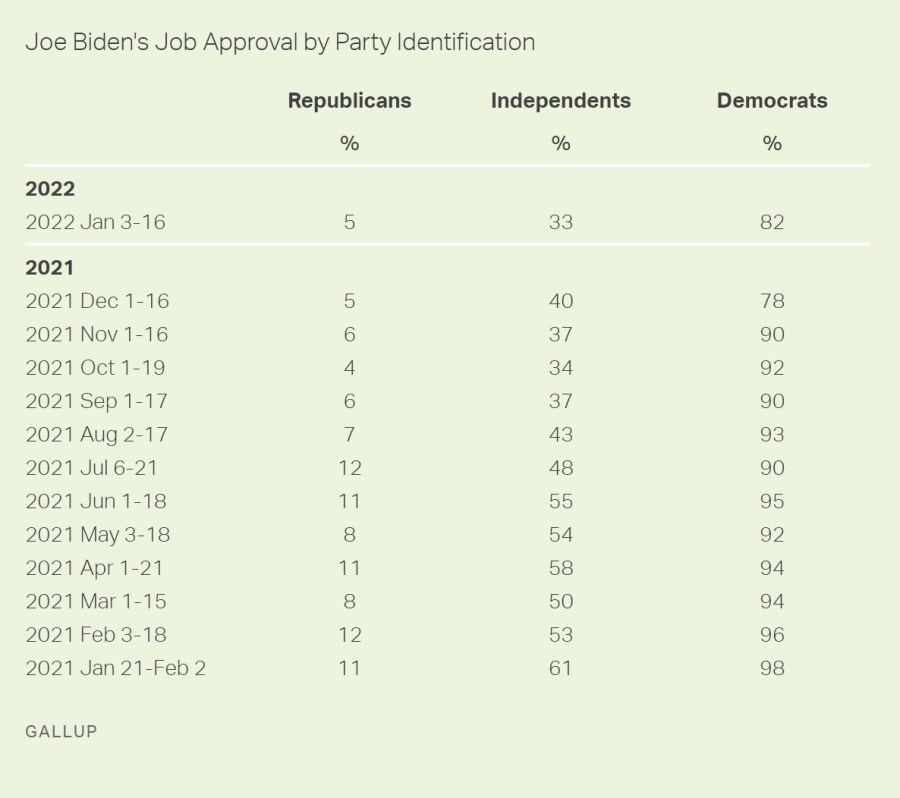
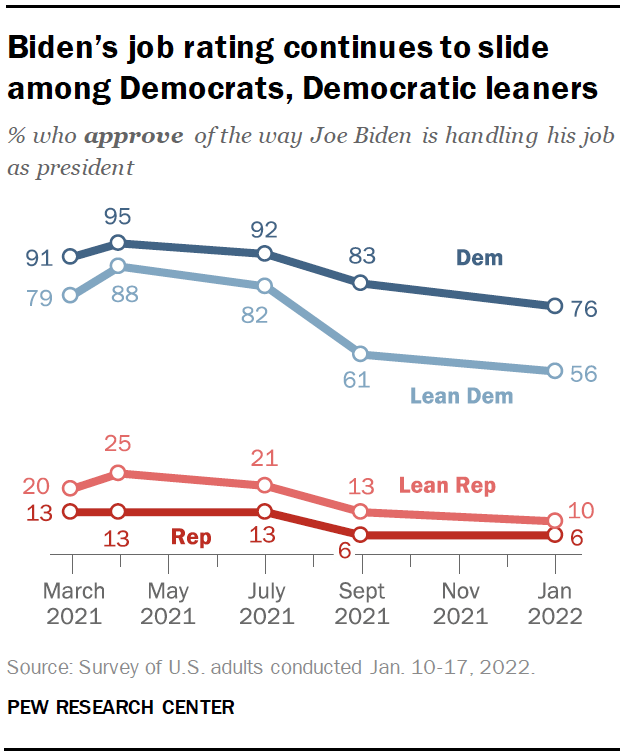
After all, how does he respond to the loudest voices? Domestically, to the frustration of many Americans, he has failed to stand up to the demands of the left, further driving a wedge that divides his nation, as evident by his precipitous loss in support among independents, partisan split found in his approval rating[54] and slide among who lean Democrat.[55]
If these are his natural instincts, what occurs when applied globally? Will the international community see what happens when a US president gives in to the world’s loudest voices, its authoritarians? Emboldening the most radical, whether at home or abroad, does little to quell tensions. It is not working – and will not work – in the US, not if America is to survive in a form that resembles the free republic that rose to prominence. It will not work in the world, not if democracy is to survive elsewhere.
Consider how the world’s belligerents may view Biden when they look at his handling of Americans. If the administration is unwilling to speak out against the more radical district attorneys and divisive members of his own party who push progressive criminal justice reform policies that limit the prosecution of crime and imprisonment of criminals,[56] largely attributed to the rise in violent crime[57] and attacks against peace officers,[58] why would they believe him willing to stand up against aggressive nations’ postures or in defense for other free nations? If he is unwilling to protect his own country’s borders and people by properly vetting and stemming the tide of illegal immigration, or abandoning Americans overseas to the discretion of the Taliban,[59] why would he protect another country’s borders halfway across the world? If he failed to hold to his word and try to unite his own nation,[60] why would he try to unite other nations?
Regardless of any good will of Biden’s decisions, if ever there were a time to move against American interests, the time is now. What value are the president’s words when his actions show little willingness to stop the advances?
Checkers, Chess and Mahjong
It is evident that there are three (3) great regional threats in the world today – in Europe, Asia and the Middle East. And they are all aggressive authoritarian nations with expansionary goals – Russia, China (with its puppet state, North Korea) and Iran (with the support of Islamic terrorism) respectively. How are they acting in response to the ‘Biden Doctrine?’
In fairness, the decades-long movement toward authoritarianism that has led to this moment in history has only seen a single year of a Biden administration, but this is the moment in history, and in the international game, those with clear, consistent goals looking several moves ahead are better prepared to win. Focusing on a domestic agenda, regardless of its importance, means there is little focus on the international while other players are acting. Biden and his priorities, so focused on retooling a democratic system that functioned successful enough to elect him president, will need to change if it is to stem legitimate losses to democracy worldwide. The repeated setbacks he has seen at home – the failure to pass Build Back Better or overhauling elections – provides opportunity to reorient, to redefine his presidency.
Will he succeed in the international arena in a way he has yet to do at home? Can a man, who according to former Secretary of Defense for Barrack Obama, Bob Gates, was “wrong on nearly every major foreign policy and national security issue” for decades be one to get this right?[61] Will he spell out a clear strategy and endgame that defines the threat while addressing the costs of failure?[62] Is he willing to support his words with the difficult actions? If Biden sees himself in the mold of FDR, can he learn from FDR and rally Americans in defense of democracy? Perhaps if the president had not denigrated his own people[63] and pressed so hard on progressive initiatives that Americans now believe him to be a divider,[64] he would be positioned to do so, but he will have a long arduous climb back to regain the confidence of the public and unite the country in a cause.
Democracy, freedom, could be that cause, but actions must match the words. If Americans believe him to be restricting their own freedoms through extra-legal action, as has been argued of such things as eviction moratoriums and vaccine mandates that were ultimately halted by the Supreme Court,[65] or they begin to feel unsafe in their own communities under his leadership, is he the right messenger for that?
Abroad, the collected chess master, Russia, appears content to sacrifice small pieces to gain – to suffer economic sanctions with the illegal annexation of Crimea.[66] With its eyes on Ukraine, how much more will it be permitted to take?
China, as one would in mahjong, has been patient, willing to play the long game, making a series of slow but deliberate moves toward economic and regional – if not global – prominence as it diminishes democracy.[67] Will the West allow it to take Taiwan next?
The US, by contrast, with diffused interests that are more natural to democratic nations, lives in the moment with less care for tomorrow. Its leaders, more emotional and reactive, behave as if playing a careless game of checkers, focused on jumping over its competitor in hopes of reaching the end and yelling ‘king me.’ When they get there, they may turn around only to find they have ignored the rest of the board.
They may be kings, but for how long, and at what cost?
War may or may not be avoidable, but if the US is to win in a world full of ill-intentioned adults advancing authoritarianism, its leaders will need to stop playing the child’s game. It will need to organize, articulate and execute a defense for free peoples.
America’s words and posture will need to be matched with its actions.
[1] Remarks by President Biden on America’s Place in the World, (WhiteHouse.gov, 2021)
[2] Somini Sengupta, How Biden’s Climate Ambitions Could Shift America’s Global Footprint, (The New York Times, 2021)
[3] Francis Fukuyama, The End of History and the Last Man, (1992)
[4] Samuel P. Huntington, The Clash of Civilizations? (Foreign Affairs, Vol. 72, No. 3, 1993)
[5] Editors, Korean War, (History.com)
[6] Editors, Vietnam War, (History.com)
[7] Editors, A Timeline of the U.S.-Led War on Terror, (History.com)
[8] Axis Powers, (New World Encyclopedia)
[9] Josh Zeitz, The Speech That Set Off the Debate About America’s Role in the World, (Politico, 2015)
[10] Invasion of the Soviet Union, 1941, (Britannica)
[11] Willard M. Wallace, American Revolution, (Britannica)
[12] Warren W. Hassler, American Civil War, (Britannica)
[13] Global Impact 1929-1939, (Encyclopedia.com)
[14] World War II, (Britannica)
[15] RFE/RL, Watchdog: ‘Entrenched Authoritarianism’ In Eastern Europe, Central Asia Led To More Corruption In 2021, (RadioFreeEurope/RadioLiberty, 2022)
[16] Ted Van Green and Carroll Doherty, Majority of U.S. public favors Afghanistan troop withdrawal; Biden criticized for his handling of situation, (Pew Research Center, 2021)
[17] Bradley Bowman, Afghanistan war critics blame Biden for the current chaos. They need to look in the mirror, (NBC News, 2021)
[18] Luke McGee, Afghan withdrawal leaves allies to face harsh reality of US’s departure from world stage, (CNN, 2021)
[19] Remarks by President Biden Before the 76th Session of the United Nations General Assembly, (WhiteHouse.gov, 2021)
[20] US left Bagram Airbase at night with not notice, Afghan commander says, (BBC News, 2021)
[21] Barbara Sprunt, Biden Pledges To Strike Back After Attack Kills 13 U.S. Service Members in Kabul, (NPR, 2021)
[22] Amanda Macias, 13 U.S. service members killed, 18 wounded in attack near Kabul airport, Pentagon says, (CNBC, 2021)
[23] Matthieu Aikins, Times Investigation: In U.S. Drone Strike, Evidence Suggests No ISIS Bomb, (The New York Times, 2022)
[24] Myah Ward, Biden says U.S. will stay in Afghanistan until all Americans who want to leave can do so, (Politico, 2021)
[25] Kathy Gannon, Before pullout, watchdog warned of Afghan air force collapse, (AP News, 2022)
[26] Stephen Moore, Biden’s war on American energy made us dependent, again, (Fox Business, 2022)
[27] Causes of Climate Change, (United States Environmental Protection Agency, 2017)
[28] Derek Chollet, Obama’s Red Line, Revisited, (Politico, 2016)
[29] Vladimir Soldatkin and Humeyra Pamuk, Biden tells Putin certain cyberattacks should be ‘off-limits’, (Reuters, 2021)
[30] Ian Bremmer, The ‘Strongmen Era’ Is Here. Here’s What It Means for You, (Time, 2018)
[31] Holly Ellyatt, Trump’s NATO criticism is ‘valid,’ Europe isn’t spending enough on defense, UK ex-minister says, (CNBC News, 2018)
[32] Richard Haass, The Age of America First, (Foreign Affairs, 2021)
[33] Jamie Dettmer, VOA News, European, Other World Leaders Welcome Joe Biden, (VOA, 2021)
[34] Reshma Kapadia, U.S. and China Take Steps to Reduce Financial Ties. That Spells Trouble for Chinese ADRs, (Barron’s, 2021)
[35] Holly Ellyatt, The U.S. was right – Europe has become a ‘hostage’ to Russia over energy, analysts warn, (CNBC, 2021)
[36] Ian Talley, U.S. Lifts Some Iran Sanctions Amid Stalled Nuclear Talks, (The Wall Street Journal, 2021)
[37] Tom Vanden Brook, What happened to US military equipment left behind in Afghanistan? (USA Today, 2021)
[38] Positive Reinforcement, (Dictionary.com)
[39] Alicia Adamczyk, Here’s what’s in the Democrats’ $1.75 trillion Build Back Better plan, (CNBC, 2021)
[40] Executive Order on Advancing Racial Equity and Support for Underserved Communities Through the Federal Government, (WhiteHouse.gov, 2021)
[41] Lincoln Mitchell, Biden’s voting rights failure in the Senate is his own doing, (NBC News, 2021)
[42] James Jay Carafano, Joe Biden’s Immigration Policies Are a National Security Threat, (The Heritage Foundation, 2021)
[43] Nick Miroff, Border arrests have soared to all-time high, new CBP data show, (The Washington Post, 2022)
[44] Sarah Al-Arshani, The US Southern border saw a growing number of migrants from Russia, Ukraine, and other distant countries last month, (Business Insider, 2022)
[45] Lisa Hagen, Manchin, Sinema Face Democratic Backlash Over Filibuster Stance, (US News, 2022)
[46] Views of Joe Biden, (Pew Research Center, 2022)
[47] Jeffrey M. Jones, U.S. Political Party Preferences Shifted Greatly During 2021, (Gallup, 2022)
[48] Aamer Madhani, Biden declares ‘America is back’ in welcome words to allies, (AP News, 2021)
[49] Inaugural Address by President Joseph R. Biden, Jr, (WhiteHouse.gov, 2021)
[50] Editor, Pulling on a Thread: Unravelling the Republic, (The Offence, 2021)
[51] Jonathan Swan and Hans Nichols, Scoop: Leaked document reveals Biden’s Afghan failures, (Axios, 2022)
[52] Matthew Karnitschnig, Disbelief and betrayal: Europe reacts to Biden’s Afghanistan ‘miscalculation’, (Politico, 2021)
[53] James Hohmann, How Biden’s transformation ran aground, (The Washington Post, 2021)
[54] Presidential Approval Ratings – Joe Biden, (Gallup, 2022)
[55] Biden Starts Year Two with Diminished Public Support and a Daunting List of Challenges, (Pew Research Center, 2022)
[56] Press Briefing by Press Secretary Jen Psaki, January 20, 2022, (WhiteHouse.gov, 2022)
[57] David A. Graham, America Is Having a Violence Wave, Not a Crime Wave, (The Atlantic, 2021)
[58] Xander Landen, ‘War on Cops’: Biden Faces New Crisis in Wake of High-Profile Violence Against Police, (Newsweek, 2022)
[59] Jack Detch, Kelly Kimball and Robbie Gramer, State Department: Thousands of U.S. Residents Still Stuck in Afghanistan, (Foreign Policy, 2021)
[60] Editor, Pulling on a Thread: Unravelling the Republic, (The Offence, 2021)
[61] Abby D. Phillip, Bob Gates Memoir Slams Joe Biden for Being ‘Wrong’ on Foreign Policy, (ABC News, 2014)
[62] Brent D. Sadler, The United States Can’t Afford Another Vague National Security Strategy, (Foreign Policy, 2021)
[63] Remarks by President Biden on Protecting the Right to Vote, (WhiteHouse.gov, 2022)
[64] Alexandra Hutzler, More Americans Say Biden Is Dividing the Country Rather Than Unifying It, Poll Finds, (Newsweek, 2022)
[65] Sarah Westwood, Biden’s legal losses: Seven times courts have struck against administration, (Washington Examiner, 2021)
[66] Steven Pifer, Crimea: Six years after illegal annexation, (Brookings, 2020)
[67] Michael Pillsbury, The Hundred-Year Marathon: China’s Secret Strategy to Replace America as the Global Superpower, (2015)
 The Offence
One thought on “High on Luster, Shy on Muster: The Biden Doctrine and a World on the Brink”