
Over the course of a campaign for public office, candidates make promises of all sorts. Rarely, if ever, is every promise honored upon election. This is largely accepted by voters, leaving the measure by which politicians prioritize the fulfillment of campaign promises and the relative success they have in achieving them as a more appropriate means to assess whether or not they have been true to their word. And while the 2020 presidential election was largely defined as a binary choice, whether or not a voter approved of Donald Trump and his handling of the coronavirus pandemic,[1],[2] Joe Biden still provided something of a traditional policy agenda to shape his potential presidency,[3] in the process, making an array of statements and positions on policy through both the primary and general election en route to his victories.
At times, these appeared to be at odds, inconsistent, nebulous, evasive or even outright lacking, leading The Offence to question who was elected President of the United States (US).[4] Though the overarching theme of the Biden campaign and transition team was one of unity,[5] bringing the nation together, for which there has been little apparent success to date,[6] promises on policies were made, several of which have already been kept. [7] Some of the consequences of the fulfilled promises have been immediate, some will require more time before their impacts are clear and some may remain unknowable, if not predictable given the course of history and human nature itself.
Consistent, however, with the effectual tone the administration set in its first 100 days in office, he has done so by dismissing the more unifying elements of the campaign in favor of pursuing progressive priorities when addressing all matters ranging from the economy to the pandemic to immigration.
It is possible the surprising sweeping ambition of the administration could prove successful, but the risks are both real and great.
As respects the government’s role in the economy, the scope of federally funded social programs, and the prioritization of collective needs over individual rights, largely detailed in his economic and jobs policy known as Build Back Better,[8] the president has signaled his preference to move America toward a more socialistic society, as it compares to its current form.
Beyond the subjective value of such a move, there are, objectively, potential pitfalls in the plan, a plan that may have begun rather symbolically with a Day 1 executive order prioritizing environmental concerns by ending construction on the Keystone XL pipeline and, along with it, the 10,000 union jobs that were projected to accompany it.[9] The move sent thousands of Americans to the unemployment line with an unrealistic expectation that green jobs would be awaiting them,[10] that they would somehow proliferate in place of traditional jobs in the energy sector, a sort of ‘two jobs in the bush are worth more than one in the hand’ approach. These jobs have yet to manifest.
But foremost, the spending spree.
The COVID Economy: The Longer It Lasts, the More Can Be Spent
There has been an undisputed link between the pandemic and the economy. For better or worse, governments took dramatic steps in 2020 to stem the spread of the virus, aware that there would be extraordinary consequences to these actions. And many of the decisions were bipartisan, including the initial $2T Coronavirus Aid, Relief and Economic Security (CARES) Act, which was, at the time, the nation’s largest-ever stimulus package.[11] The restrictive measures and financial compensation for compliance resulted in, rather predictably, a massive contraction in the US economy.[12]
Relearned in this process is that crises position populations to accept measures they might not normally accept, including an unprecedented infusion of capital as the Federal Reserve ‘printed money’ to help cover Americans’ lost income.[13] For those who prefer expansive government solutions, particularly those which acquire and reallocate wealth though centralized planning of technocrats, this provided a primer, an example of what could be accomplished should such politicians acquire actionable power in Washington while the pandemic ensued.
They gained that power.[14]
One of the Biden campaign’s key promises was more immediate economic relief.[15] In short order, Democrats and the president bypassed input from the more fiscally conservative Republicans in creating, and passing along party lines, the $1.9T American Rescue Plan.[16] (This brought the total ‘coronavirus pandemic’ spending to $3.9T.) Rather than focusing on targeted, short-term relief that might be necessary as a result of the virus – or government responses to it – the bill included progressive ‘equity’ programs such as supplemental benefits to non-white farmers,[17] expanded and extended unemployment insurance (UI) benefits[18] and granted broad use authority enabling application to non-pandemic issues, even if such issues might be more the result of long-term, systemic policies enacted by a state.
The legislation also disproportionately funded governments that took more restrictive approaches to the crisis through use of such measures as extended lockdowns, states largely led by Democrats.[19] (Notably, the heavily-Democratic District of Columbia was projected to receive, on a per capita basis, nearly twice as much as any state.[20]) And now as the monies are reaching states, spending proposals are ranging from more equity initiatives to police body cameras,[21] which have little to no direct bearing on coronavirus, but do satisfy the concept of federally-funded redistribution of national assets in satisfying social agendas.
But this is not socialism…
Although the US Treasury has recently warned states against attempts to use the funds for pre-pandemic matters instead of relief for its citizens,[22] that did not stop the federal government from promptly sending billions to states irrespective of their immediate needs, as would prove to be the case for California, which subsequently reported a $75.7B surplus, and whose liberal governor – one under threat of recall for his very handling of the coronavirus crisis[23] – now proposes sending federal taxpayer money back to its citizens.[24]
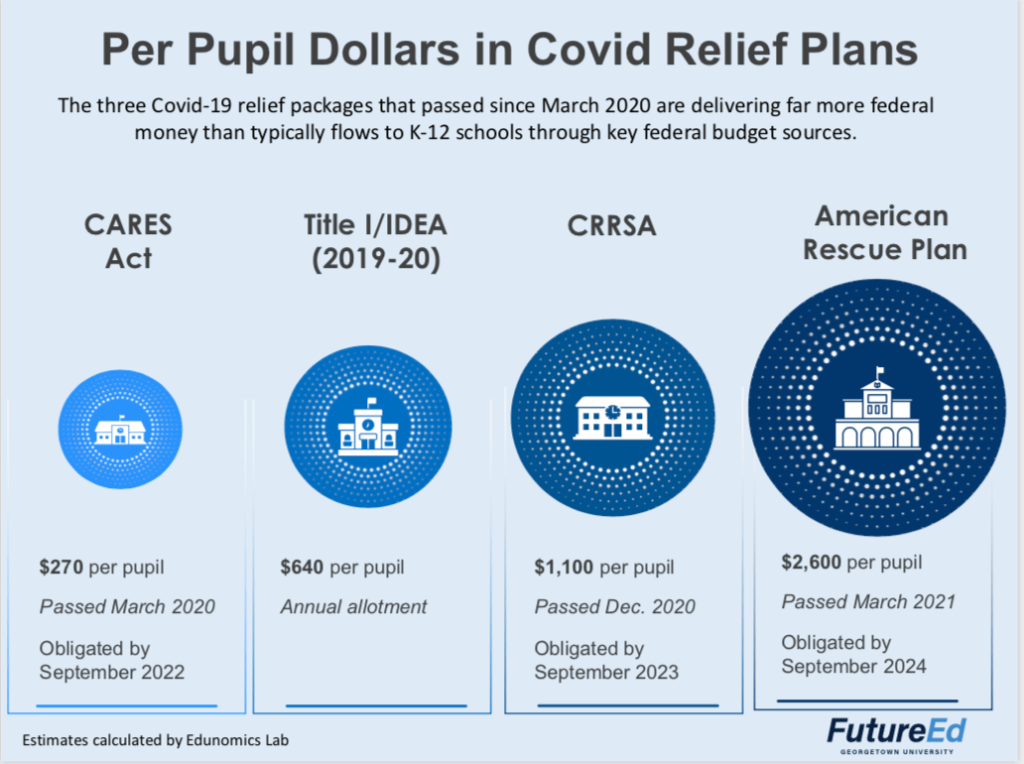
Further, approximately one third of the monies set aside in the bill are designed to be spent over nine (9) years,[25] well beyond the projected life of the pandemic, as with the billions set aside for public schools,[26] indicating that the measures within the legislation have less to do with coronavirus and more to do with big spending on domestic programs, spending that could be debated on its merits, but was avoided by Democratic leaders in the name of urgency. Never mind, some of the ‘urgent’ funds will not be expended for years:
And the expediency with which the bill moved through Congress allowed its leaders to turn their focus on Biden’s new spending proposal – the $2.3T infrastructure plan entitled American Jobs Plan,[27] of which only a share would qualify as traditional infrastructure.[28] (This would bring the total ‘coronavirus pandemic’ spending to $6.2T.) Reminiscent of the ‘shovel-ready’ claims made by the Obama-Biden administration when urging the passing of the 2009 $800B stimulus plan[29] – American Recovery and Reinvestment Act[30] – the current president is lauding the new bill as a jobs builder, one which would create 19 million jobs over the next decade, a claim proven false by fact checkers.[31]
Upon further evaluation, it was determined that the president’s claim included more than 16.3 million jobs expected to occur without the proposed legislation courtesy of existing programs and the natural course that is the free market economy, indicating only about 2.6 million jobs – over the next ten (10) years – would result from passing the massing plan. This remains a notable number, but 84% less than promised, well shy of immediate…and at a quite the cost.
And whilst this bill remained under discussion, the nation’s infrastructure was actually struck with a cyberattack resulting in a shutdown at Colonial Pipeline, affecting the delivery of approximately 45% of the fuel consumed on the East Coast.[32] The attack, a first of its nature in US history, resulted in lines at gas stations unseen since the national shortages experienced in the 1970s.[33] (It was only brought back online after the attackers were paid a reported $5M in ransom.[34])
Ironically, the president’s “infrastructure” bill is devoid of dedicated security to prevent such attacks on this hard infrastructure,[35] giving preference to items such as public housing and clean technologies,[36] technologies revolving around the electric grid, which might prove even more vulnerable to such attacks.[37] And, interestingly, in the wake of the attack, Department of Energy (DOE) Secretary, Jennifer Granholm, proceeded to acknowledge that pipelines are the best way to transport oil,[38] seeming to have momentarily lost sight that one of the president’s first actions was to stop construction on a major oil pipeline.
Should the infrastructure bill become law under its current form, the combined cost of Biden’s first two (2) bills – proposed in only a few months – would come in at $4.2T, presuming the costs do not rise upon implementation, which has been debated.
But this is not socialism…
While negotiations on the second bill were underway, Biden took the opportunity to propose yet a third potentially historic bill, the American Families Plan,[39] coming at a price of $1.8T,[40] much higher than that initially advertised by the administration.[41] (This could bring the total ‘coronavirus pandemic’ spending to $8T.) The latest plan calls for free community college, an extension of the federal government’s reach into the economy with measures such as twelve weeks of guaranteed paid family and medical leave,[42] and a general expansion of the welfare state with government-funded childcare and provisions to permanently expand existing entitlement programs, including subsidies under the Affordable Care Act.[43]
Should the president succeed in passing all three (3) bills, it would result in over $6T[44] in spending in only a few months of governing, roughly 50% more than the entire fiscal year (FY) 2019 budget of $4.4T.[45]
Taken in their entirety, the proposals constitute what some conservatives describe as “Biden’s cradle-to-grave government.”[46]
Guided largely by broad acceptance of Keynesian economics[47] – a theory originating out of an attempt to explain the Great Depression and advocating for greater government spending during periods of economic downturn – politicians have increasingly embraced the spending proposals, but the accompanying portion to this theory is a lowering of taxes.
The president has proposed increasing taxes.
But this is not socialism..?
(See Part II: The Biden Administration Is Tackling the Economy: Will It Go Down?)
[1] Ed Kilgore, For Trump in 2020: It’s the Virus, Stupid! (New York Magazine, 2020)
[2] Harry Enten, Trump’s handling of the coronavirus is the only election issue that matters, (CNN, 2020)
[3] Asma Khalid and Barbara Sprunt, Biden Counters Trump’s ‘America First’ With ‘Build Back Better’ Economic Plan, (NPR, 2020)
[4] Editor, Congratulations President-elect Purple Monkey Dishwasher, (The Offence, 2020)
[5] Will Weissert, Biden promotes unity, turns to business of transition, (PBS, 2020)
[6] Editor, Pulling on a Thread: Unravelling the Republic, (The Offence, 2021)
[7] Biden Promise Tracker, (Politifact, 2021)
[8] Build Back Better, (White House, 2021)
[9] Editorial Board, Biden’s Keystone Pipeline Kill, (Wall Street Journal, 2021)
[10] Ebony Bowden, Jen Psaki mocks reporter when asked about Keystone pipeline job losses, (New York Post, 2021)
[11] Romina Boccia and Justin Bogie, This Is How Big the COVID-19 CARES Act Relief Bill Is, (Heritage, 2020)
[12] Martin Crutsinger, US economy shrank 3.5% in 2020 after growing 4% last quarter, (Associated Press, 2021)
[13] Brent Schrotenboer, US is ‘printing money to help save the economy from the COVID-19 crisis, but some wonder how far it can go, (USA Today, 2020)
[14] Editor, Pulling on a Thread: Unravelling a Republic, (The Offence, 2021)
[15] Kelly Anne Smith and Taylor Tepper, Joe Biden Is President-Elect Of The US. Here Are 5 Ways He’ll Affect Your Finances, (Forbes, 2020)
[16] Grace Segers and Melissa Quinn, House approves $1.9 trillion COVID relief package, sending bill to Biden, (CBS News, 2021)
[17] Jeanine Santucci, How $1.9 trillion COVID-19 relief bill aims to help Black and socially disadvantaged farmers, (USA Today, 2021)
[18] Federal Provisions for Unemployment, (Employment Development Department, 2021)
[19] Andy Sullivan and Jason Lange, Analysis: Urban states come out ahead, rural states get less in Biden’s COVID-19 relief bill, (Reuters, 2021)
[20] Urban states benefit in Biden’s $1.9 trillion COVID-19 package, (Reuters, 2021)
[21] Stacey Barchenger, States have billions of dollars from the American Rescue Plan. Now they have to spend it, (North Jersey, 2021)
[22] Shruti Singh and Amanda Albright, Treasury Rescue Won’t Bail Out Chicago, New Jersey From Debt, (Bloomberg, 2021)
[23] Jerusalem Demsas, The effort to recall California Gov. Gavin Newsom, explained, (Vox, 2021)
[24] Kevin Yamamura, California has a staggering $75.7B budget surplus, (Politico, 2021)
[25] G. William Hoagland, The American Rescue Plan: Is it $1.9 Trillion or $3.5 Trillion? (Bipartisan Policy Center, 2021)
[26] Phyllis W. Jordan, What Congressional Covid Funding Means for K-12 Schools, (FutureEd, 2021)
[27] Elisabeth Buchwald and Andrew Keshner, Biden’s selling point for this $2.3 trillion infrastructure plan – most jobs would NOT require a college degree, (Market Watch, 2021)
[28] Arturo Conde, Biden Infrastructure Plan: Inside the $2.3 Trillion American Jobs Plan, (Smart Asset, 2021)
[29] Tim Worstall, The Reason That Shovel Ready Stimulus Didn’t Work Is That There Wasn’t Any Stimulus, (Forbes, 2021)
[30] H.R.1 – American Recovery and Reinvestment Act of 2009, (Congress.gov, 2009)
[31] Glenn Kessler, Biden’s pitch that the economy ‘will create 19 million jobs’ if infrastructure is passed, (The Washington Post, 2021)
[32] Eric Tucker, Cathy Bussewitz and Alan Suderman, FBI names pipeline cyberatttackers as company promises return, (Associated Press, 2021)
[33] Greg Myre, Gas Lines Evoke Memories Of Oil Crises In The 1970s, (NPR, 2021)
[34] William Turton, Michael Riley and Jennifer Jacobs, Colonial Pipeline Paid Hackers Nearly $5 Million in Ransom, (Bloomberg, 2021)
[35] Eric Geller, $2 trillion can build a lot of infrastructure. But can the U.S. secure it? (Politico, 2021)
[36] Jessica Jennings, What’s in the American Jobs Plan? (National Association of Counties, 2021)
[37] David Stringer and Heesu Lee, Why Global Power Grids Are Still Vulnerable to Cyber Attacks, (Bloomberg, 2021)
[38] Houston Keene, Biden’s energy sec says ‘pipe is the best way’ to transport fuel, sparks backlash regarding Keystone XL pipeline, (Fox News, 2021)
[39] Fact Sheet: The Americans Families Plan, (White House, 2021)
[40] Kevin Breuninger, Biden to unveil $1.8 trillion plan for children and families – here’s what’s in it, (CNBC, 2021)
[41] Stephen Gandel, Biden’s American Families Plan will cost $900 billion more than White House predicts, study says, (CBS news, 2021)
[42] Kelly Anne Smith, Biden Unveils $1.8 Trillion American Families Plan: Here’s How It Will Affect Your Bottom Line, (Forbes, 2021)
[43] Marie Fishpaw, Lindsey M. Burke, Doug Gadger, Matthew D. Dickerson, Leslie Ford, Rachel Greszler and Robert Rector, 5 Things You Need to Know About Biden’s $1.8 Trillion American Families Plan, (Heritage, 2021)
[44] Glenn Thrush, Here is a guide to Biden’s three big spending plans – worth about $6 trillion, (The New York Times, 2021)
[45] The Federal Budget in 2019: an Infographic, (Congressional Budget Office, 2020)
[46] Editorial Board, Biden’s Cradle-to-Grave Government, (Wall Street Journal, 2021)
[47] Investopedia Staff, Keynesian Economics, (Investopedia, 2020)
 The Offence