
The reputations of election polls and pollsters are on the line. In 2016, the statewide polls showed Hillary Clinton with a solid lead heading into the election, so solid that the advanced analytics at FiveThirtyEight only gave Donald Trump a 28.6% chance of winning.[1] The polls were wrong. Albeit with a slim margin on a state-by-state basis, estimated to be around 80,000 votes in three states,[2] Donald Trump became the president-elect with a commanding 304 – 227 vote in the Electoral College. The stunning results forced pollsters to evaluate what went wrong and reconsider their approach.[3]
Prior to the election, given the incredible visible support for Trump, as reflected in many of his 137 general election rallies,[4] he and his surrogates consistently claimed that a social desirability bias[5] formed a “hidden Trump vote” that pollsters were failing to count.[6],[7] This argument was frequently dismissed at the time and its significance discounted following the election, suggesting it is likely to remain inconsequential this year.[8] It is, in fairness, difficult to quantify. Others argued FBI Director James Comey’s announcement that Hillary Clinton’s emails were under further investigation was an impactful October surprise too late to be captured by the polls.[9] Some suggested that Republicans, who are generally more reserved, are less likely to participate in polls, thusly under-sampled overall.[10] Yet others argued that the undecided vote remained so long, so unusually high – upwards of ten percent – that the election could have easily swung either way without the polls being wrong.[11]
Whatever the case, pollsters have repeatedly insisted that they have made appropriate corrections to properly reflect the reality on the ground,[12] sufficient for many to believe that 2020 will not be a repeat.[13] Time will tell, but what if they have not corrected the issues? What if the polls remain just as flawed as they were in 2016?
In fact, there are those who contend that the “hidden Trump vote” may be more substantial,[14] possibly extending to minority groups, though there are also indications that Trump has more professed support amongst Hispanic and black voters this year.[15] And early voter enthusiasm, considered by some to be a predictor of voter turnout, has uncharacteristically favored the incumbent,[16] providing some reason to believe Trump’s supporters are more likely to cast a ballot for their candidate than are Biden’s prospective voters.[17] How much do the polls account for this?
In the final weeks of 2016, there was a noticeable shrinking of Clinton’s lead over Trump.[18] With clear indicators that momentum has been on Trump’s side over the last month, we are seeing something similar this year,[19] but is it too little, too late? Analysis shows that among the twelve states (Arizona, Florida, Georgia, Iowa, Michigan, Minnesota, Nevada, North Carolina, Ohio, Pennsylvania, Texas and Wisconsin) and two districts (Maine-2 and Nebraska-2) that will determine the presidential election, all but Georgia, Minnesota, Texas and Wisconsin have been trending in Trump’s favor over the final month of the campaign. (Georgia remains relatively stable with an edge to Biden while Texas continues to show Trump ahead.)
Since the election is, essentially, a binary choice between the two candidates, raw vote share is less relevant than whom receives more votes than the other. The following polls and trend line are measured by differential in preference, wherein a poll above zero reflects a preference for Biden while below zero reflects a preference for Trump:
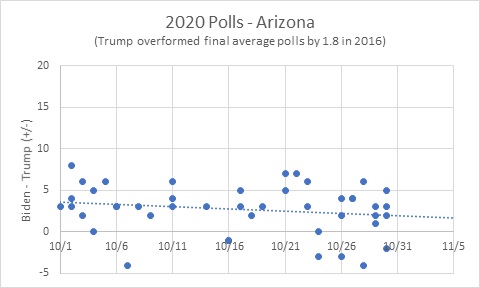
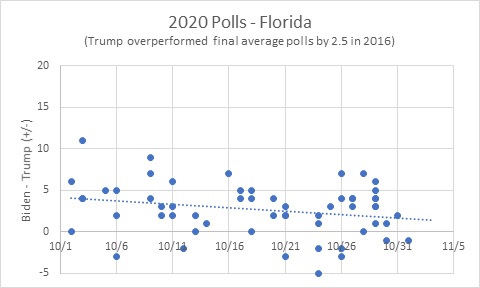


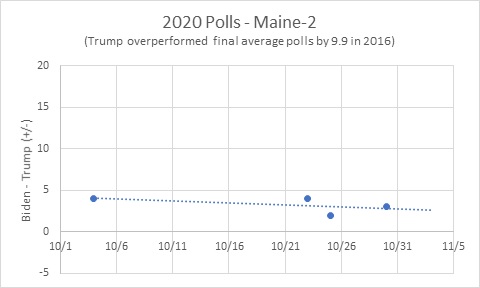
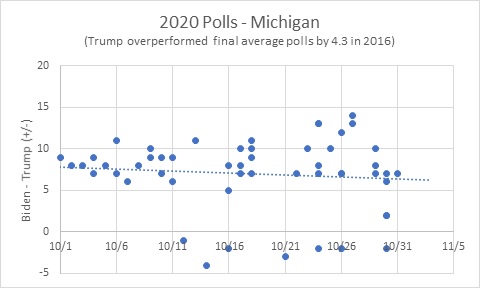

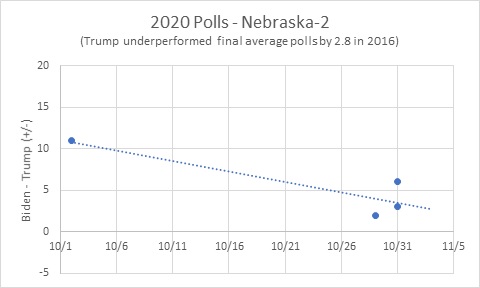

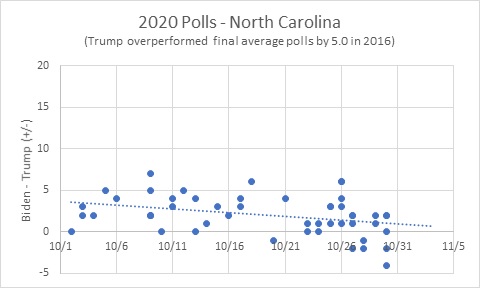
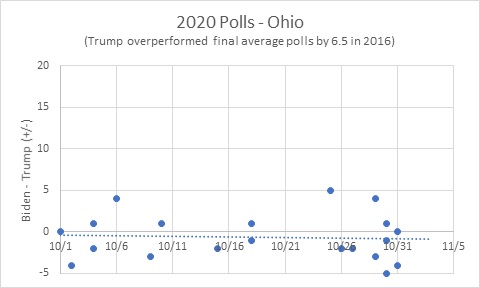
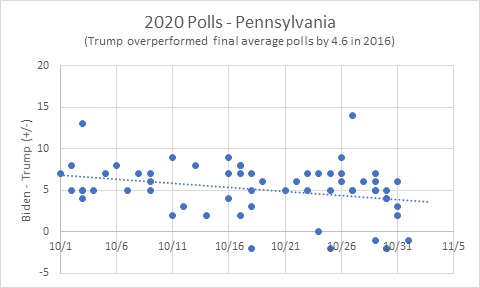
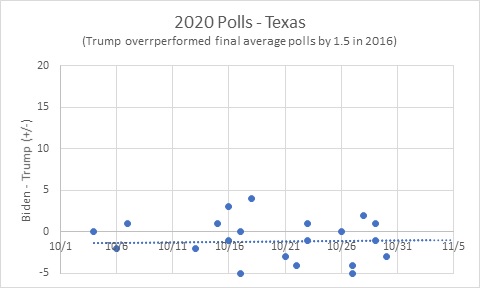

Clearly, Joe Biden began with some substantial leads in these polls. There may not be enough time to eclipse the deficit from which Trump began, nor is it assured that the trend will continue. And with over 94 million votes cast prior to November 3rd,[20] the trend to election day may be less relevant than prior years, but we would do well to consider that the early voter is the eager and committed. Preferring more time to weigh their options – often until election day – undecided voters are understandably less likely to vote early, and these are the voters suspected to decide the contest.
Evaluating the Evaluators
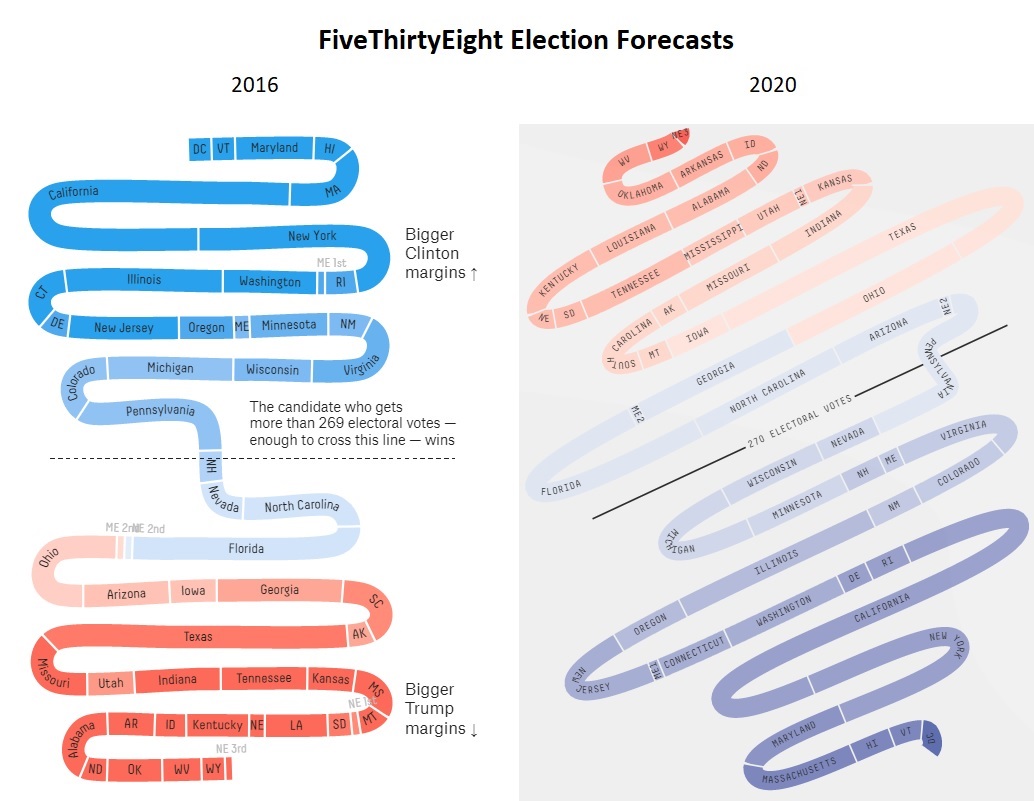
This year, FiveThirtyEight’s sophisticated modeling only provides an edge to Trump in three of the swing states – Texas, Iowa and Ohio – and a 10% chance to win with an exceptionally narrow path to victory,[21] and with good cause. Unadjusted, the raw polls show Biden in a commanding lead to be elected the 46th president.
With two critical states, Florida and Pennsylvania, both on the east coast, we may have early indicators of where the election is heading Tuesday night. Because of its 29 electoral votes, if Trump loses Florida, the election is all but over; however, if Trump wins, it becomes more of a toss-up. Similarly, a Biden loss in Pennsylvania would narrow his path to victory, making him the underdog.[22] Considering he claims roots in the Keystone state, a loss there could be a bellwether.
If the pollsters are right and there is no value to trending, Biden will win both states as part of an electoral landslide, 351 – 187.
So how do the polls and projections compare to 2016? There is a remarkable degree of familiarity, as evident by FiveThirtyEight:
What, then, if the industry’s post-2016 corrections were insufficient and the accuracy of the polls remains unchanged? What if the Hunter Biden alleged influence peddling scheme[23] and the general media blackout[24] and social media censorship[25] that resulted is the late ‘Comey announcement’ of 2020? What if Republicans are more frequently hanging up on pollsters and the “hidden Trump vote” is real, immeasurable? What if the Trump rallies are not an anomaly and the enthusiasm gap is as it was in 2016? What if the trend continues through to election day?
By plotting the nearly 400 polls published by 12:00 am (ET) November 3rd,[26] projecting the final month through to the election, and comparing the result to Trump’s 2016 differential in polls-to-performance (PTP), we find the following:
| Electoral Votes | Trend to 2020 Election | 2016 PTP* | Trend + PTP | |
|---|---|---|---|---|
| Arizona | 11 | -1.79 | 1.80 | 0.01 |
| Florida | 29 | -1.46 | 2.50 | 1.04 |
| Georgia | 16 | -1.20 | 1.39 | 0.19 |
| Iowa | 6 | 1.33 | 6.31 | 7.64 |
| Maine-2 | 1 | -2.61 | 9.89 | 7.28 |
| Michigan | 16 | -6.20 | 4.33 | -1.87 |
| Minnesota | 10 | -9.06 | 5.78 | -3.28 |
| Nebraska-2 | 1 | -2.79 | -2.80 | -5.59 |
| Nevada | 6 | -4.63 | -1.32 | -5.95 |
| North Carolina | 15 | -0.66 | 4.96 | 4.30 |
| Ohio | 18 | 0.83 | 6.53 | 7.36 |
| Pennsylvania | 20 | -3.61 | 4.62 | 1.01 |
| Texas | 38 | 0.97 | 1.49 | 2.46 |
| Wisconsin | 10 | -7.47 | 6.67 | -0.80 |
Methodology:
- Rather than using the release date, polls were plotted at the polling period midpoint to capture the average date of the poll;
- Where concurrent polls were conducted for both registered and likely voters, only the likely voter poll was included;
- Due to their poor rating and prolific nature, which would skew results by overrepresentation, the internet polling services, SurveyMonkey and Swayable, were excluded; and,
- A Trend + PTP positive number reflects a potential Trump vote share exceeding Biden, negative Biden exceeding Trump, if the 2020 polls are as accurate as they were in 2016.
Unadjusted, this is quite consistent with FiveThirtyEight’s forecast, showing Trump trending to lose all the swing states and districts except the same Iowa, Ohio and Texas.
Obviously, the polls will not be off by the precise margins of 2016; however, adjusted for the 2016 polls-to-performance, this year’s historically divisive contest will result in a narrow 279 – 259 win for Donald Trump in the Electoral College.
In short, we may very well be in store for a long, close contest. The stress of this election cycle may persist.
Should either candidate appear to have come out on top by such a small margin, a prompt concession is unlikely. Legal challenges are anticipated and a single state’s disputed contest and/or a decisive court case could be sufficient to flip the results of the election either way, making all the polls and projections little more than a thought exercise.
What if, for example, a hotly contested Arizona becomes the post-election battleground that decides the winner as Florida was in 2000? (Comment: In the modeling, Arizona was the only state to flip in the final hours before midnight. Prior to that, the model projected Biden with a historically narrow 270 – 268 win courtesy of Nebraska-2 and its one vote. If it turns out that Biden held Arizona despite the closing trend, might that be due to some premature mail-in ballots?) The lawsuits are already underway across the country. With a solid conservative majority on the Supreme Court, one which leans toward strict constructionism, might Trump’s nominees help decide the election in his favor? If so, Democrats’ greatest fears will become a reality.
Considering the political rancor and civil unrest of 2020, what would be next?
[1] Who will win the presidency? (FiveThirtyEight, 2016)
[2] Philip Bump, Donald Trump will be president thanks to 80,000 people in three states, (The Washington Post, 2020)
[3] Li Zhou, How pollsters are responding to problems that came up in 2016, (Vox, 2018)
[4] List of rallies for the 2016 Donald Trump presidential campaign, (Wikipedia, 2020)
[5] Andy Brownback and Aaron Novotny, Social desirability bias and polling errors in the 2016 presidential election, (ScienceDirect, 2018)
[6] Philip Bump, Could pollsters be missing hidden Trump voters? (The Washington Post, 2016)
[7] Steven Shepard, GOP insiders: Polls don’t capture secret Trump vote, (Politico, 2016)
[8] Galen Druke, Clare Malone, Perry Bacon Jr. and Nathaniel Rakich, Secret Trump Voters Didn’t Decide 2016 And Probably Won’t Swing 2020, (FiveThirtyEight, 2020)
[9] Nate Silver, The Comey Letter Probably Cost Clinton The Election, (FiveThirtyEight, 2017)
[10] Dr. Benjamin Knoll, Why Do The Polls Keep Getting It Wrong? Many Republicans Have Stopped Taking Surveys, (HuffPo, 2017)
[11] Jacob Jarvis, Undecided Voters Were Key to Trump’s Win in 2016. Will They Deliver Again? (Newsweek, 2020)
[12] What’s Changed Since Polls Were Wrong About 2016’s Presidential Election, (NPR, 2020)
[13] Derek Thompson, Don’t Sweat the Polls, (The Atlantic, 2020)
[14] Zack Stanton, ‘People Are Going To Be Shocked’: Return of the ‘Shy’ Trump Voter? (Politico, 2020)
[15] Nate Cohn, The Election’s Big Twist: The Racial Gap Is Shrinking, (The New York Times, 2020)
[16] Justin McCarthy, High Enthusiasm About Voting in U.S. Heading Into 2020, (Gallup, 2019)
[17] Amid Campaign Turmoil, Biden Holds Wide Lead on Coronavirus, Unifying the Country, (Pew Research Center, 2020)
[18] Tom Kludt, National polls: Tight race, Clinton hanging on, (CNN, 2016)
[19] William Cummings, The week in polls: Trump gains in 9 of 12 swing states, but Biden still leads in 10 of them, (USA Today, 2020)
[20] Lauren Feiner, More than 94 million ballots have been cast ahead of Election Day, over two-thirds of 2016’s turnout, (CNBC, 2020)
[21] 2020 Election Forecast, (FiveThirtyEight, 2020)
[22] Fadel Allassan, Nate Silver: Without Pennsylvania, Biden becomes an underdog,” (Axios, 2020)
[23] Peter Schweizer and Seamus Bruner, Longstanding claims of Biden corruption all but confirmed with Hunter’s emails, (New York Post, 2020)
[24] The Editors, The Media’s Shameful Hunter Biden Abdication, (National Review, 2020)
[25] Social media’s struggle with self-censorship, (The Economist, 2020)
[26] Latest Polls, (FiveThirtyEight, 2020)
 The Offence
2 thoughts on “Donald Trump Reelected 279 – 259, if the Polls Are as (In)Accurate as They Were in 2016”