Both President Joe Biden’s legacy and the modern progressive movement are on the line.
What is resonating with the public and who will learn what from the results of today’s elections? Where is the country headed and will anybody change course?
The issue that has dominated this election cycle is inflation, and Americans increasingly blame the president for the state of the economy.[1] With dismal approval ratings,[2] the president has had to cherry-pick economic numbers as part of an effort to convince voters they are not feeling what they are feeling.[3] He claims credit for reduction in unemployment[4] without recognizing that state and local government lockdown policies – driven largely by Democratic leaders – gave initial rise to unemployment, or that the subsequent reductions coincided with decreasing covid-driven restrictive policies, which he did not control. Indeed, his preference was to continue restrictions, singling out red states that were leading the recovery[5] and its Republican governors who led a return to normalcy with criticism of “Neanderthal thinking.”[6] Had he gotten his way with more cautious extensions of lockdown-style policies, no doubt, high unemployment rates would have persisted.
What, then, could the leader of the Democratic party do for his colleagues when the public is losing faith in his leadership?
Just last year, he visited neighboring Virginia to stump for his party’s nominee in the governor’s race.[7] The Republican, Glenn Youngkin, won.[8] Since then, few Democrats have called for his assistance, instead making efforts to distance themselves from the president, both physically and with his policies.[9] Consequently, his campaigning for 2022 candidates has been largely restricted to his ‘hometown state’ of Pennsylvania[10] and deep blue states like California, where he took the opportunity to stress his climate agenda goal of shutting down coal-fired power plants, which would further restrict supplies amidst an existing energy crisis[11] he has helped create by disincentivizing fossil fuel production.[12]
If, despite his multiple trips to the former, he fails to even help John Fetterman get elected to the Senate, what influence will does he still have amongst the public?
The Results Are Poised to Prove Historic
What should be expected of today? It has grown increasingly possible that Democrats will face a stunning rebuke – a failure that, should the models hold, might be likened to that of 1946, even 1894.
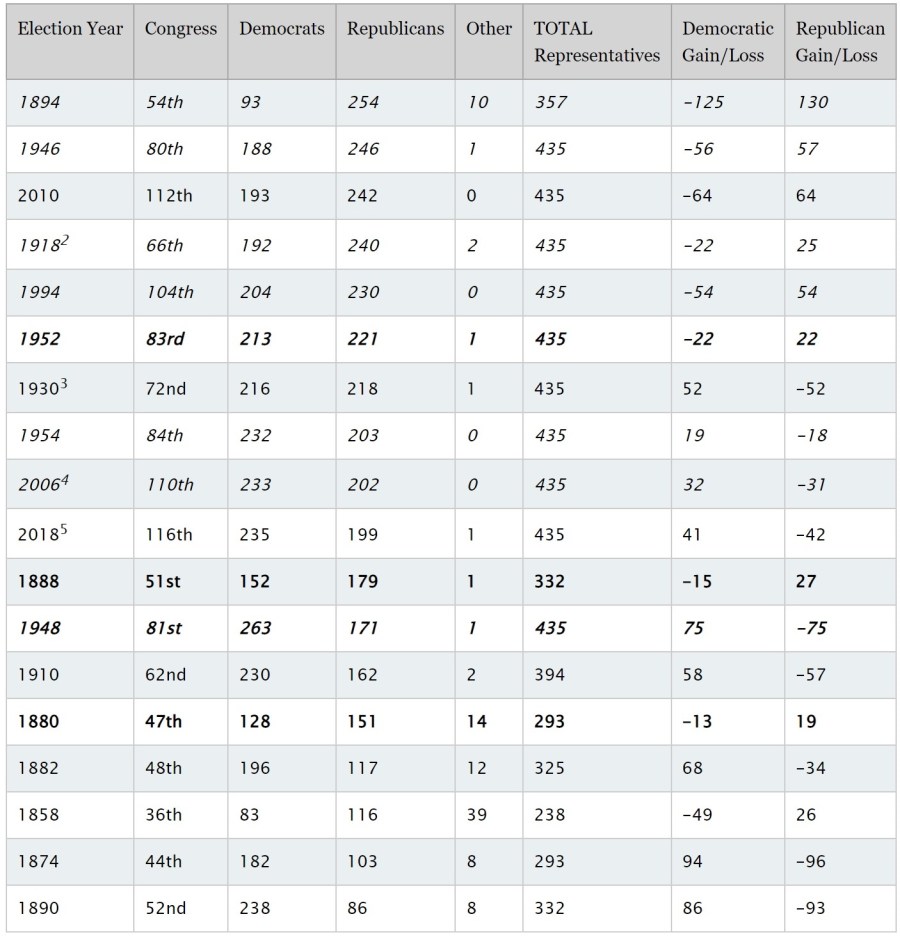
In 1946, Democrats suffered a net loss of 56 seats in the House following the end of World War II and the New Deal social spending programs.[13]
In 1894, they lost a net 125 seats.[14] For a variety of reasons, such losses will not be sustained in 2022. Notable, however, this election followed the Panic of 1893 and voters clearly held Democrats responsible for their handling of the ensuing recession, which rings familiar today.
Majority Changes in the House of Representatives, 1956 – Present
Source: House of Representatives
Most analysts have described the potential outcome in terms of the net gain/loss of seats, and it is projected Republicans could net as much as 35 seats in the House[15] and two (2) in the Senate[16] – despite an unfavorable map[17] – while gaining several governorships.[18] By comparison, this does not sound particularly historic; however, it would be misleading to assess Republican success by net gains without considering from where they start. With the 2020 general election, rather favorable to Republicans other than Trump,[19] they ended up with one of the largest minorities in House history,[20] and no minority in the Senate, albeit the Democrat Vice President casts the tie-breaking vote. Thus, the potential for gains in the House is limited. More revealing would be the size of their majorities. If they gain those 35 House seats, they will have a 247 – 188 majority.
And that is where one would arrive at those comparisons to yesteryear. Not since 1894 has a Republican midterm swing resulted in such a majority, i.e., 254 – 93 – 10. (There were only 357 members then, making that swing ever more dramatic.) In 1946, Republican gains resulted in a 246 – 188 – 1 majority. Thus, by the measure of majorities, should the GOP net those 35 House seats, it could be described as the greatest rebuke of a ruling party’s agenda since 1894.
Papers and books will be written exhausting the issues that determined this election, but should this result, there will be little spin to save that story for progressives. Few will paint the more liberal policies as blameless for the discontent they elicited in the electorate. As warned, Democrats may very well have undone themselves, sacrificed their future for temporary progressive goals and programs that could be reversed by Republicans in the coming years.
But that is based on the models, not the vote itself.
Is Democracy a Threat to Democracy?
Beginning with the election of Trump, persisting through his presidency and capped with the tumultuous event on January 6, pundits have proclaimed America’s democracy “hangs in the balance.”[21] This has come in the form of charging the former president’s Make America Great Again (MAGA) adherents, or the “ultra-MAGA,”[22] with election lies and denials, suggesting the events at the United States (US) capitol are a precursor for widespread national upheaval were Republicans to regain control of Congress. This, those such as Biden contend, is the most critical concern for the public, not the economy, nor crime nor any of the other issues that plague the minds of voters, with, perhaps, abortion rights being the exception.[23]
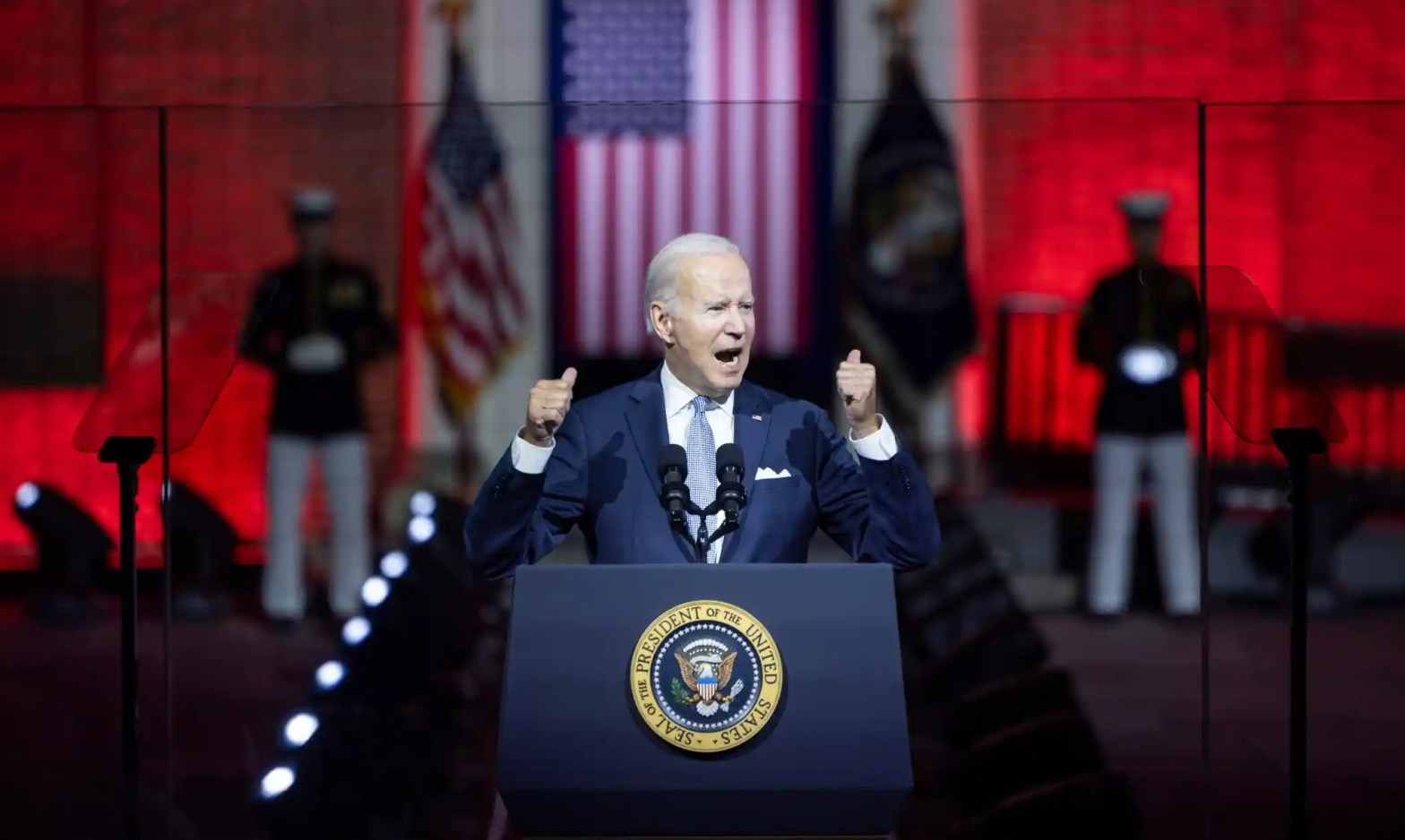
But the largely partisan investigation into the riot[24] that was supposed to confirm the ‘threat’ has not appeared to capture the public’s attention. And so the president has made efforts to relitigate the case with public proclamations and primetime speeches, including one flanked by US military personnel,[25] a rather ominous appeal. Still, despite the attention it has received on left-leaning networks like CNN and MSNBC, it has failed to make it into the top issues amongst voters.

Source: Harvard Caps Harris Poll
Is it the message or the messenger?
The voters blame rampant government spending and Washington’s policies for inflation and rising prices.[26] With the continued misinformation and lies that have come from the president respecting the issues that matter most to the public, recently eliciting a “bottomless Pinocchio” rating from The Washington Post,[27] why would the voters believe his latest cries about an issue of much lesser importance to them? Will this move the needle?
When the president makes statements that are outside Americans’ common concerns or simply do not ring consistent with their everyday experiences, his claims begin to strain credulity. If the message he conveys about the top issues like the economy or inflation display a disconnect amongst the public, it is more difficult to connect on other issues, such as ‘the state of democracy is on the ballot.’
And when making such proclamations in the late days of the election, rather than focusing on those top issues, it reinforces the disconnect the public may feel coming from his administration, that the president’s priorities are not theirs.
What is more, though sounding like a broad appeal to safeguard democratic processes, he quickly turns partisan by blaming the former president and the candidates he has endorsed. This, despite the fact his own party spent millions in support of some of those same candidates in the Republican primaries, believing them to be easier opponents for the general election.[28] It is difficult to escape the cynicism. If democracy is on the ballot and these are its threats, why make such an effort to avoid Republicans who did not threaten democracy? The message this sends? Democracy is so important that Democrats had to spend millions to ensure they faced less moderate Republicans in the general election because…even those moderate Republicans are a threat to democracy?
How many MAGA Republicans will have been elected, in part, courtesy of Democrats’ funding and what responsibility with the assume for that?
Insisting that democracy means the rule of the people, what will Biden do should the people exercise democracy and send him a Republican Congress with which to work? Will he become an election denier of a new kind, holding that the people do not really want what they sent these new members to do? Will he and progressive ideologs stand in the way of the Republican agenda, in the way of “democracy?”
Once the partisan lens has been lifted, it begins to sound more like Democrats are less afraid of losing democracy than they are afraid of democracy itself. Granted, as Democratic South Carolina Representative, James Clyburn, indicated, 1930s Germany was a functioning democracy before Adolph Hitler became chancellor – not through election, but through appointment[29] – but he was not voted in with a majority. It was through inside politics, exploiting the shortcomings of the Weimar Republic’s federal government, that he acquired and expanded control. Raising such comparisons is misleading and dangerous. (The Representative would later retract his more emotive reaction that a sweeping Republican victory would mean “the end of the world.”[30])
From another perspective, it could appear that the party in power is more concerned about losing power, as if the threat is not from democracy, it is democracy. After all, democracy is not truly on the ballot, it is the ballot.
And voters will be exercising it by choosing their vision for America.
As to that vision, whereby the more technocratic preferences of the left are to concentrate power at the higher levels and disseminate policy across the board, treating Washington, D.C. more like the capitol of an empire rather than a republic, the preferences of the right are to distribute power to the people, the states, in a fashion more traditional of a republic. If by democracy Democrats mean ‘empire,’ perhaps they are right. But republics thrive, empires collapse, and the Constitution was not established for the latter.
In its simplest, claiming that democracy is under threat, Biden has assessed democracy as the threat.
Icarus Politics Are Costing Democrats the Future
Despite the repeated refrains, this election is not the ‘most important in our lifetime.’ But that may be around the corner with 2024 and the choice for president. This election is but a precursor, a forbearer of things to come. And while waves crash, sea changes are more permanent. And the seas are changing. To avoid a degree of political insignificance, following any consequential gains from the GOP, as happened to them in the wake of prior historic elections coming out of historic crises, Democrats would have to learn how to navigate the new. Until then, the future will look Republican. And if history holds, that was the inevitable.
The president says this is a battle for the soul of the nation.[31] Regardless of whether voters agree with the goals of the left, voters clearly do not want to endure these birth pangs on the way to the progressive utopia.
With all the rhetoric, their efforts to fundamentally transform America, perhaps Americans simply want America to remain America. With a Republican victory in Congress, for those that chose not to undo it, their country will have held.
But progressives have had some success. Even if they lose tomorrow, they will have had their moment. But for the Democratic Party to remain influential in the coming years, it may need to remember what it is and that could require jettisoning the radicals that are bringing it to brink of national irrelevance. Perhaps it is time to relegate the progressives to obscurity rather than raising them to power, a feat that will prove difficult, for the members that survive this election may come almost exclusively from non-competitive districts, giving some of its louder voices the misleading, even delusional, impression that their party needs to triple down on the leftist policies – those same policies that would have been proven resoundingly rejected.
It appears the time has come for Democrats to escape the confines of academia – with its focus on high-minded ideals based on theories, even science – and return to the ideas of the ordinary citizens, perhaps a William Jennings Bryan-type response to those massive losses in 1894 and the resulting political realignment.
To be competitive in a new paradigm, to narrow the divide between citizens and lower the temperature in public discourse, a more successful course would be to follow the Oklahoma example and put forth more moderate nominees.[32] (To be sure, the country would benefit from Republicans doing the same.)
But with significant Republican wins – a critical blow – so would begin the slow decline of the American Progressive movement.
Voters may be on the verge of bringing an end to the ivory tower ‘Icarus politics’ of the left. The more one is to deny realities, the more they are likely to get burned by them. And that is where a party finds itself when pushing policies outside the mainstream, dismissing the public’s self-professed interests.
Reality returns. It burns.
When all is said and done, when the autopsy is complete, this election is likely to indicate that liberals have shifted so far to the left that the average American now finds him/herself more aligned with the ‘far right’ candidates he/she voted into office. That is the lesson Democrats would do well to learn. Will they reorient themselves?
For a Democrat Party that remains out of touch, out of excuses, out of time, so would cometh that generational loss of power.
But should the Republican Party fail to take advantage of all the headwinds in their favor, to achieve substantive success, some introspection will be required on their part.
[1] Harry Enten, More bad news for Biden: More Americans are blaming him for the state of the economy, (CNN, 2022)
[2] 55% of American disapprove of the president, (Reuters, 2022)
[3] Diana Furchtgott-Roth, Biden’s Tales of an Economic “Recovery” Don’t Mesh With Reality, (The Heritage Foundation, 2022)
[4] Statement by President Joe Biden on the October Jobs Report, (White House, 2022)
[5] Rebecca Rainey and Eleanor Mueller, Red states lead economic recovery, giving GOP ammo against Biden’s spending plans, (Politico, 2022)
[6] Covid: Biden says ‘Neanderthal thinking’ behind lifting of mas rules, (BBC News, 2021)
[7] Quinn Scanlan, Biden stumps for McAuliffe in Virginia ahead of gubernatorial election, (ABC News, 2021)
[8] J. Kim Murphy, Republican Glenn Youngkin Wins Virginia Governor Election, (Reuters, 2021)
[9] Tamara Keith, Biden is on the midterm campaign trail. But he’s not welcome everywhere, (NPR, 2022)
[10] Kevin Liptak, MJ Lee and Jeremy Diamond, Biden’s quite campaign season brings him back to familiar territory in Pennsylvania, (CNN, 2022)
[11] Jacob Zinkula, Biden says coal plans will be replaced by cheaper solar and wind power. Joe Manchin says he owes coal workers ‘an immediate and public apology.’ (Yahoo! News, 2022)
[12] Katie Tubb, Biden’s Radical, Anti-Fossil Fuel Energy Policy Costs Americans Dearly, (The Heritage Foundation, 2022)
[13] The 1946 House Elections, (United States House of Representatives)
[14] Greg Timmons, The Biggest Landslide in Midterm Election History, (History, 2018)
[15] Battle for the House 2022, (RealClearPolitics, 2022)
[16] Battle for the Senate 2022, (RealClearPolitics, 2022)
[17] Burgess Everett and John Bresnahan, Republicans dash to defend perilous 2022 Senate Map, (Politico, 2020)
[18] 2022 Governor Races, (RealClearPolitics, 2022)
[19] Domenico Montanaro, The 2020 Election Was A Good One For Republicans Not Named Trump, (NPR, 2020)
[20] Phillip Bump, Here’s how narrow the Democratic House majority is, (The Washington Post, 2021)
[21] Juan Williams, Democracy hangs in the balance in midterms, (The Hill, 2022)
[22] Courtney Subramanian, Biden warns that ‘ultra MAGA’ Republicans will lead the U.S. down a ‘path to chaos’. (Los Angeles Times, 2022)
[23] Lisa Lerer and Elizabeth Dias, At Campaign’s End, Democrats See Limits of Focus on Abortion, (The New York Times, 2022)
[24] Chelsey Cox and Sarah Elbeshbishi, Who is on the January 6 committee. Meet the members and chair, (USA Today, 2022)
[25] Brianna Keilar, Biden’s use of Marines during Philadelphia speech adds to debate over politicization of the military, (CNN, 2022)
[26] Poll: Americans Largely Blame Inflation and Rising Prices on Government, (Americans for Prosperity, 2022)
[27] Glenn Kessler, A Bottomless Pinocchio for Biden – and other recent gaffes, (The Washington Post, 2022)
[28] Andrew Dorn and Robert Sherman, Dems spent millions backing GOP candidates – will it backfire? (NewsNation, 2022)
[29] Adolf Hitler is named chancellor of Germany, (History, 2022)
[30] Ronn Blitzer, Clyburn doubles down on Nazi Germany comparison, but does sharp about-face on ‘end of the world’ remark, (Fox News, 2022)
[31] Remarks by President Biden on the Continued Battle for the Soul of the Nation, (White House, 2022)
[32] Ryan Lacroix, In Oklahoma, former Republican Joy Hofmeister will face Gov. Kevin Stitt in November, (NPR, 2022)
 The Offence