
(See Part II: Twenty Questions for 2020 Democrats)
Part III of III:
It has been said that ‘history does not repeat itself, but it rhymes.’ With recent events being likened to the chaos and upheaval of the 1960s, it would be appropriate to further reflect on those elections.
In 2016, we witnessed both parties battling for their souls with establishment candidates competing against upstart outsiders[1] for whom support slowly coalesced, though only one would become the nominee…
The Democrats. In 1968, the Democratic Party was in turmoil.[2] In the contentious 1968 convention, Democrats nominated a moderate option, the establishment Vice President Hubert Humphrey. Following his defeat, they nominated the unabashed liberal Senator George McGovern in 1972. In 2016, they nominated their moderate option, the establishment Secretary of State Hillary Clinton. Following her defeat, former Vice President Joe Biden is now poised to represent them, but only after he abandoned many of his long-held moderate policies and largely agreed to concede to the more liberal flank led by independent Senator Bernie Sanders,[3] a self-described democratic-socialist who, it seems, spent his first 45 years in politics considering the Democratic Party too moderate for him.
The Republicans. Nixon famously exited politics in 1962 with the parting words to the media, “you don’t have Nixon to kick around anymore.” When he returned amidst the social chaos of the 1960s, he campaigned as the law and order candidate who would bring peace at home and an end to the Vietnam War using the slogans Nixon’s the One! and Vote Like Your Whole World Depended on It. When Trump officially entered politics in 2016 he was immediately (and continually) castigated by the media while campaigning as a pro-police, pro-military, America-first candidate who would Make America Great Again, and he has since framed the contest as America vs. Socialism, insight that seems to have grown increasingly prescient.
Come the general election, how did things work out the last time clear socialistic idealism was confronted with tangible realism? Following the progressive presidency of Johnson, with domestic turmoil and a war overseas, Nixon and his Realpolitik defeated Humphrey and McGovern in successive elections:
| Electoral Vote | Popular Vote Percent | |
|---|---|---|
| Kennedy (1960) | 303 – 219 | 49.7 – 49.5 |
| Johnson (1964) | 486 – 52 | 61.1 – 38.5 |
| Nixon (1968) | 301 – 191 – 46 | 43.4 – 42.7 |
| Nixon (1972) | 520 – 49 | 60.7 – 37.5 |
Source: Britannica.com
Is history repeating itself? The comparisons are imperfect but the periods rhyme. In some ways, 2020 could be more appropriately compared to 1968; however, Obama has been described as a progressive in the mold of Johnson.[4],[5] (Note: Johnson’s victory was much more decisive than Obama’s reelection but it is worth noting the former occurred under extraordinary circumstances, namely following the assassination of his party’s president.)
| Electoral Vote | Popular Vote Percent | |
|---|---|---|
| Obama (2008) | 365 – 173 | 52.9 – 45.7 |
| Obama (2012) | 332 – 206 | 50.9 – 47.1 |
| Trump (2016) | 304 – 227 | 46.0 – 48.1 |
Source: Britannica.com
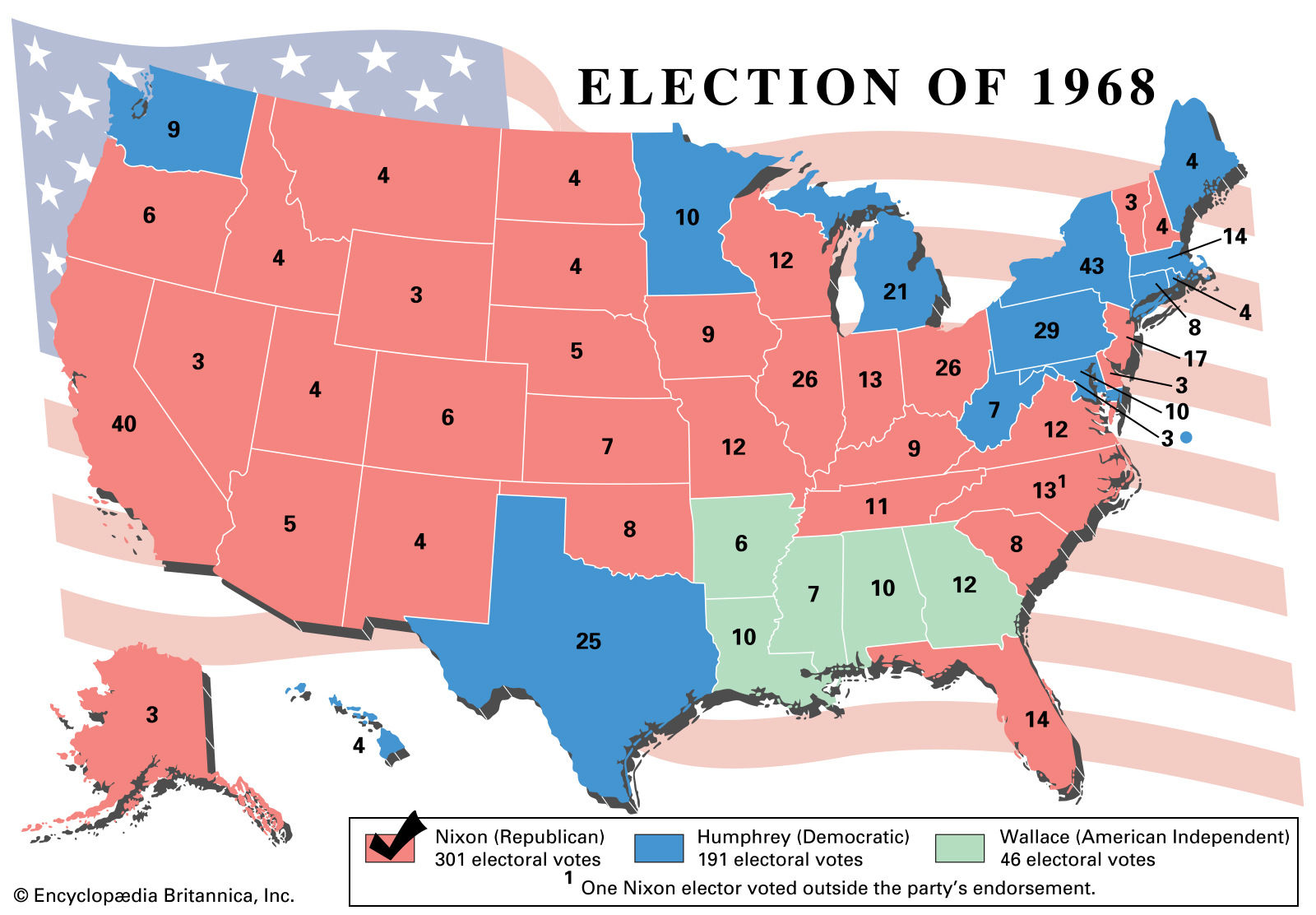

If the eight years of the Kennedy and Johnson administrations are compared to Obama’s eight years, one could proceed to compare the subsequent 1968 and 2016 presidential campaigns and elections. They followed eight (8) years of progressive policies, there was no incumbent on the ballot, Democrats selected the moderate establishment candidate in a contentious primary. The Republican won by similar margins, both in electoral college – Nixon (301), Trump (304) – and popular vote – Nixon (43.4%), Trump (46.0%) – and the progressive legacies began to crumble thereafter.[6]
Prisoners of the Moment
Where convenient, we seem to ignore history, as if to say ‘the past is the past,’ ‘the here and now is all that matters,’ ‘we reached this point in time independently.’ But are there lessons from the past?
With the election months out, there is still time, but if the 1968 – 2016 comparison continues to play into a 1972 – 2020 comparison and Democrats do little more than rest on moral platitudes this election cycle, dismissing moderate and conservative fears over the upheaval Americans are witnessing and experiencing, they may again carry little more than the devoted and run into a reckoning along the lines of 1972’s electoral wipeout. Does the socialistic movement of the 1960s compare to today’s? In the broadest sense, most certainly. The Great Society and the civil rights movement arrived by way of peace, love, civil protests, common Christian faith, belief in equal treatment under God, calls for freedom, egregious everyday visible institutional racism, i.e. “Whites Only” signs, and the images of police attacks on unarmed protestors.[7]
By the late 1960s, however, more radical revolutionary movements, albeit representing a relatively small segment of the population, began to gain traction. These included the Black Liberation Army (organized in 1960), the Black Panthers (1966), and the Weather Underground (1969), which arose out of the Students for a Democratic Society (1960). Each of these, to differing degrees believed in Black Power, subscribed to the idea of class warfare and supported the use of more militant means to achieve communist goals of redistribution of society’s resources.[8]
The nonviolent resistance of the 1960s is largely credited with the civil rights successes of the decade, which included the Civil Rights Acts of 1960, 1964 and 1968, as well as the Voting Rights Act of 1965. And this common cause for rights is immortalized in Martin Luther King, Jr.’s speech “I Have Dream,” in which he called for a largely race-blind society. But these legislative successes, the progress, largely came to a halt once demonstrations and violence increased at the hands of the more militant activists.
By 2008, the peaceful elements continued to dominate the call for more equal treatment and the nation elected its first black president, who emphasized addressing the plights of minorities. Since then, however, the movement for equality has become visibly infused with the more radical leftist elements of Black Lives Matter (2016) and the loosely organized Antifa, which both advocate anti-establishment, Marxist principles of redistribution of wealth and race-based policies through confrontation, not too dissimilar from their 1960s spiritual forbearers. Consequently, the modern movement has transcended traditional peaceful methods, embracing nihilistic secular faith in central government, woke religiosity with ‘shout-downs’ calling for subjective justice,[9] assertions of the more nebulous systemic racism,[10] disrespect for authority[11] and violence that has resulted in images of attacks on innocent civilians and the police.
Whereas principles of peace helped capture the sentiment of the public in the 1960s and late 2000s, eras that included structural and symbolic change respecting race, the injections of principles of conflict – in some cases violence – have proven divisive, both in the past and present. Rather than productive, this latter route may have been counter-productive in its previous iteration. What about today? Can Democrats win the hearts and minds of most Americans by tacitly, or symbolically, burning their country to the ground?
Following the civil rights success, the silent majority rejected the subsequent violence with Nixon on the ticket.[12] Liberals contend Obama expanded equal rights with ACA, his economic policies and actions supportive of gay rights and clean air,[13] yet he did not go far enough overall.[14],[15] Is there recent precedent to believe the subsequent violence will yield different results with Trump on the ticket?
If we have seen this play out before when Nixon faced a categorical liberal and was re-elected despite an overseas war and unrest at home, and the nation is now facing the dual crises of COVID-19 and civil unrest, perhaps a different question deserves some consideration…
…Is everything coming up Trump?
The tribalism and political self-sorting of the nation[16] is likely to make any electoral victory for Republicans or Democrats less decisive than previous elections; however, come November 4, should Democrats fail to pivot to the middle, we may be able to look back at this and consider Behold the History, Why Republicans Won in a Landslide.
Would we be surprised (again)?
Author’s note: In the two weeks after this article was submitted, the following occurred:
- Seattle’s mayor praised[17] anarchists’ creation of the ‘autonomous zone’ in her city;[18]
- Numerous monuments across the country have been defaced and/or unlawfully toppled[19] with little criticism from Democratic leaders;
- Christian monuments to Jesus[20] and the cross[21] have come under attack;
- Armed citizens have taken to the street to ‘protect’ their neighborhoods;[22],[23]
- A Republican senator’s op-ed defending the conditional use of the military to protect the peace resulted in the resignation of a New York Times editor over its newsroom’s outrage;[24]
- Twitter selectively censored the President’s warnings about violence;[25] and,
- Another incumbent New York Democrat has reached the verge of losing a primary to a politically inexperienced progressive candidate who calls for defunding the police.[26]
[1] Stephen Collinson, Outsider Campaigns Seek Inside Track, (CNN, 2016) https://www.cnn.com/2016/04/11/politics/donald-trump-bernie-sanders/index.html
[2] Allen Matusow, The Unraveling of America: A History of Liberalism in the 1960, (1984)
[3] Shane Goldmacher and Sydney Ember, Biden, Seeking Democratic Unity, Reaches Left Toward Sanders’ Ideas, (New York Times, 2020) https://www.nytimes.com/2020/04/09/us/politics/biden-sanders-medicare-student-debt.html
[4] Priscilla Totiyapungprasert, Obama Compared to LBJ, (Politico, 2008) https://www.politico.com/story/2008/12/obama-compared-to-lbj-016232
[5] Dan Balz, Obama and LBJ: Measuring the Current President Against the Past One, (The Washington Post, 2014)
[6] Julian E. Zelizer, What Trump-Era Democrats Can Learn From LBJ, (The Atlantic, 2018) https://www.theatlantic.com/politics/archive/2018/02/democrats-lbj/552989/
[7] Editors, Civil Rights Movement (History, 2009) https://www.history.com/topics/black-history/civil-rights-movement
[8] Bryan Burrough, Days of Rage: America’s Radical Underground, the FBI, and the Forgotten Age of Revolutionary Violence (2015)
[9] Michael Levenson, For Mayor Jacob Frey of Minneapolis, a Stinging Rebuke, (The New York Times, 2020) https://www.nytimes.com/2020/06/07/us/minneapolis-mayor-jacob-frey-walk-of-shame.html
[10] Black Lives Matter Protestors Nationwide Speak Out Against Systemic Racism and Police Brutality, (CBS News, 2020) https://www.cbsnews.com/video/black-lives-matter-protesters-nationwide-speak-out-against-systemic-racism-and-police-brutality/
[11] Benjamin Siegel, Why Protestors Want to Defund the Police After George Floyd’s Death, (ABC News, 2020) https://abcnews.go.com/Politics/protesters-defund-police-george-floyds-death/story?id=71123610
[12] Joe Chatham, On 1968: A Period of Realignment, (Heterodox Academy, 2017) https://heterodoxacademy.org/on-1968-a-realigning-period/
[13] Derek Thompson, Thanks, Obama, (The Atlantic, 2016) https://www.theatlantic.com/business/archive/2016/09/obamas-war-on-inequality/501620/
[14] Robert Scheer, Why the Affordable Care Act Hasn’t Gone Far Enough, (HuffPost, 2017) https://www.huffpost.com/entry/why-the-affordable-care-act-hasnt-gone-far-enough_b_58f490c3e4b04cae050dc8d0
[15] David Bookbinder, Obama Had a Chance to Really Fight Climate Change. He Blew It., (Vox, 2017) https://www.vox.com/the-big-idea/2017/4/28/15472508/obama-climate-change-legacy-overrated-clean-power
[16] BIll Bishop, The Big Sort: Why the Clustering of Like-Minded America is Tearing Us Apart, (2008)
[17] Ian Schwartz, Seattle Mayor Durkan: CHAZ Has a “Block Party Atmosphere,” Could Turn into “Summer of Love,” (Real Clear Politics, 2020), https://www.realclearpolitics.com/video/2020/06/12/seattle_mayor_durkan_chaz_has_a_block_party_atmosphere_could_turn_into_summer_of_love.html
[18] Evan Bush, Welcome to the Capitol Hill Autonomous Zone, where Seattle protesters gather without police, Evan Bush, (Seattle Times, 2020), https://www.seattletimes.com/seattle-news/welcome-to-the-capitol-hill-autonomous-zone-where-seattle-protesters-gather-without-police/
[19] Rachel Scully and James Bikales, A List of the Statues Across the US Toppled, Vandalized or Officially Removed Amid Protests, (The Hill, 2020) https://thehill.com/homenews/state-watch/502492-list-statues-toppled-vandalized-removed-protests
[20] Aila Slisco, White Jesus Statues Should Be Torn Down, Activist Shaun King Says, (Newsweek, 2020), https://www.newsweek.com/white-jesus-statues-should-torn-down-black-lives-matters-leader-says-1512674
[21] Richard White, This Monument to White Supremacy Hides in Plain Sight, (New York Times, 2020), https://www.nytimes.com/2020/06/23/opinion/drakes-cross-white-supremacy.html
[22] Jason Wilson, Rightwing Vigilantes on Armed Patrol After Fake Rumours of Antifa Threat, (The Guardian, 2020), https://www.theguardian.com/us-news/2020/jun/06/rightwing-vigilante-armed-antifa-protests
[23] Leah Simpson and Karen Ruiz, Armed Protesters ‘Take Over’ the Streets Near the Wendy’s Parking Lot Where Rayshard Brooks Was Killed and Use Crude Roadblocks to Prevent People from Getting to Their Hoes on the Day of His Funeral, (Daily Mail, 2020), https://www.dailymail.co.uk/news/article-8453575/Armed-protesters-Wendys-parking-lot-Rayshard-Brooks-killed-day-funeral.html
[24] Rishika Dugyala, NYT Opinion Editor Resigns After Outrage Over Tom Cotton Op-ed, (Politico, 2020), https://www.politico.com/news/2020/06/07/nyt-opinion-bennet-resigns-cotton-op-ed-306317
[25] Rachel Lerman, Twitter Slaps Another Warning Label on Trump Tweet About Force, (Washington Post, 2020), https://www.washingtonpost.com/technology/2020/06/23/twitter-slaps-another-warning-label-trump-tweet-about-force/
[26] Jacob Pramuk, Two Powerful House Democrats from New York are in Danger of Losing Their Primaries, (CNBC, 2020), https://www.cnbc.com/2020/06/24/new-york-primary-results-eliot-engel-carolyn-maloney-in-danger.html
 The Offence
One thought on “The Rhythms of History”