
Part I of III:
The common refrain every four years is “this is the most important election in our lifetime.” In a normal year, this is hyperbole. Is there anybody who wants to believe 2020 is normal? The divisions in the U.S. have been solidifying since 1968, when Richard Nixon was elected employing what has been described as both the Southern strategy and suburban strategy, an election that has been identified as beginning the political party realignment in the nation.[1]
Hearts have been hardening. Between the left-right media schism, polarizing rhetoric, coronavirus, historic unemployment, riots and mass protests we are experiencing a year few would have envisioned.
This looks like that proverbial election.
Conservatives conserve. In its simplest, they are the ones who tend to favor maintaining traditions. Progressives progress. They are in search of change, however defined. In 2020, they are seeking massive change at the expense of traditional policy and institutions. Consider for a moment, if the last liberal Democratic president, Barrack Obama, ran on change, advocated for “fundamentally transforming” the nation, served two terms and has been out of office for fewer than four years, what is that massive change today and what is required to achieve it?
Irrespective of election results, liberals can continue to work toward effecting change through the judicial system and hope that that their preferred outcomes survive higher court rulings but if they are going to succeed in enacting institutional change, they will need the legislative and executive system working in tandem. This allows for codified change. But even this may be insufficient for lasting change. Recent history indicates that is likely to require broad pubic agreement on principle and policy.
But there is nothing inherently good about change. Change is simply change. Those who propose it are responsible for providing a convincing argument that change is for the better. This is their charge. How might they do it?
Coalition Does Not Mean Consensus
In 2008, the Democratic Party built the famous “Obama Coalition,” one relying heavily of women, non-whites and the young, and it enabled them to win the election;[2] however, the dismantling of the Obama legacy through expiration of policies and successor executive actions exemplifies the fundamental flaw in the failure to build national consensus, a consensus that transcends demographics and can yield an undeniable broad governing coalition between the elected branches. These latter coalitions are those that codify lasting, transformative policy.
The Affordable Care Act (ACA) is recognized as Barrack Obama’s signature achievement. It has proven to be one of the most divisive pieces of legislation in recent memory, as reflected during the legislative process when Republican Scott Brown won the special election for the deceased Edward Kennedy’s Senate seat in the liberal stalwart of Massachusetts, proving to be a harbinger of things to come for Democrats across the nation. Indeed, ACA was so divisive, its support so tenuous, that this special election forced Senate Democrats to pass its final version through budget reconciliation, having failed to hold onto a filibuster-proof majority.
Although accomplished through the legislative process, and with significant negotiation, it still passed both the Senate and House without a single vote from Republicans, 60 – 39 (prior to reconciliation) and 219 – 212, respectively.[3] It was then further sustained through successive executive actions,[4] some which would become subject to court opinion, with a significant case still pending.[5] ACA was not a product of national consensus.
Consequently, it should not surprise us that the legislation and the manner it passed (and was sustained) helped fuel the Tea Party Movement, the 2010 Republican takeover of Congress[6] and the hardened partisan lines that we have seen since, culminating in the 2016 election of Donald Trump, the anti-Obama, anti-establishment candidate. As opponents of ACA would see it, Obama set the stage – when you are in power, forgo bipartisanship, exercise the full extent of your power, enforce your will on the other half of the country, consensus no more, bordering on what Enlightenment thinkers such as John Stuart Mill and Alexis de Tocqueville described as the ‘tyranny of the majority.’ Lessons were learned.
Methods or favorability notwithstanding, ACA has proven considerably difficult to undo because, unlike rules and procedures determined by executive fiat, it was passed through the legislative process. As evidenced in the Federalist Papers, legislation is supposed to be difficult to pass, to require a certain measure of broad support, which is why there are two houses of Congress (No. 62, James Madison) and the checks and balances (No. 51, Madison). This is intended to guard against the fleeting whims and emotions of today’s simple majorities and its impositions upon minorities.
By contrast, many of the regulations and foreign policies enacted by Obama, which were not typically subject to Congressional approval, have been undermined or overturned by Trump.[7] As politicians continue to exercise processes that fall short of those intended by the founding fathers, the resulting policies become subject to the capricious nature of politics.
Live by the stroke of a pen, die by the stroke of a pen.
Hope Is Not a Policy
Aspiration can be motivating, positive and productive but when hope relies on life being dreadful, people so angry, that whomever presents themselves the alternative to an incumbent will win regardless of whether the issues before us are legitimately addressed, it is merely spiteful. It is also arrogant and lazy to hope that the economy will be so great that incumbents will be reelected regardless of what they offer. Hope can be good, it is based on principles, but in politics principles require policies to be productive, and policies require convincing.
History indicates that transformative change, as progressives envision it, does not simply require an election win, it requires genuine broad support that leads to wins with majorities across the nation in both the electoral and popular vote, an irrefutable mandate that does not leave half the country subject to the other half’s will, whether that half is defined by population or states. The population needs to buy into it.
Are efforts being made to reach this in 2020?
Unlike recent presidents, the liberal Democratic standard bearers of yesteryear succeeded in gaining broad national support. Franklin D. Roosevelt’s New Deal and the Great Society policies of Lyndon B. Johnson were made possible following historic contests, including those in which they earned the largest shares since the uncontested election of 1820:
| Electoral Vote | Popular Vote Percent | |
|---|---|---|
| Roosevelt (1932) | 472 – 59 | 57.3 – 39.6 |
| Roosevelt (1936) | 523 – 8 | 602 – 36.5 |
| Roosevelt (1940) | 449 – 82 | 54.7 – 44.8 |
| Roosevelt (1944) | 432 – 99 | 53.3 – 45.8 |
| Johnson (1964) | 486 – 52 | 61.1 – 38.5 |
| Average | 472 – 60 | 57.3 – 41.0 |
Source: Britannica.com
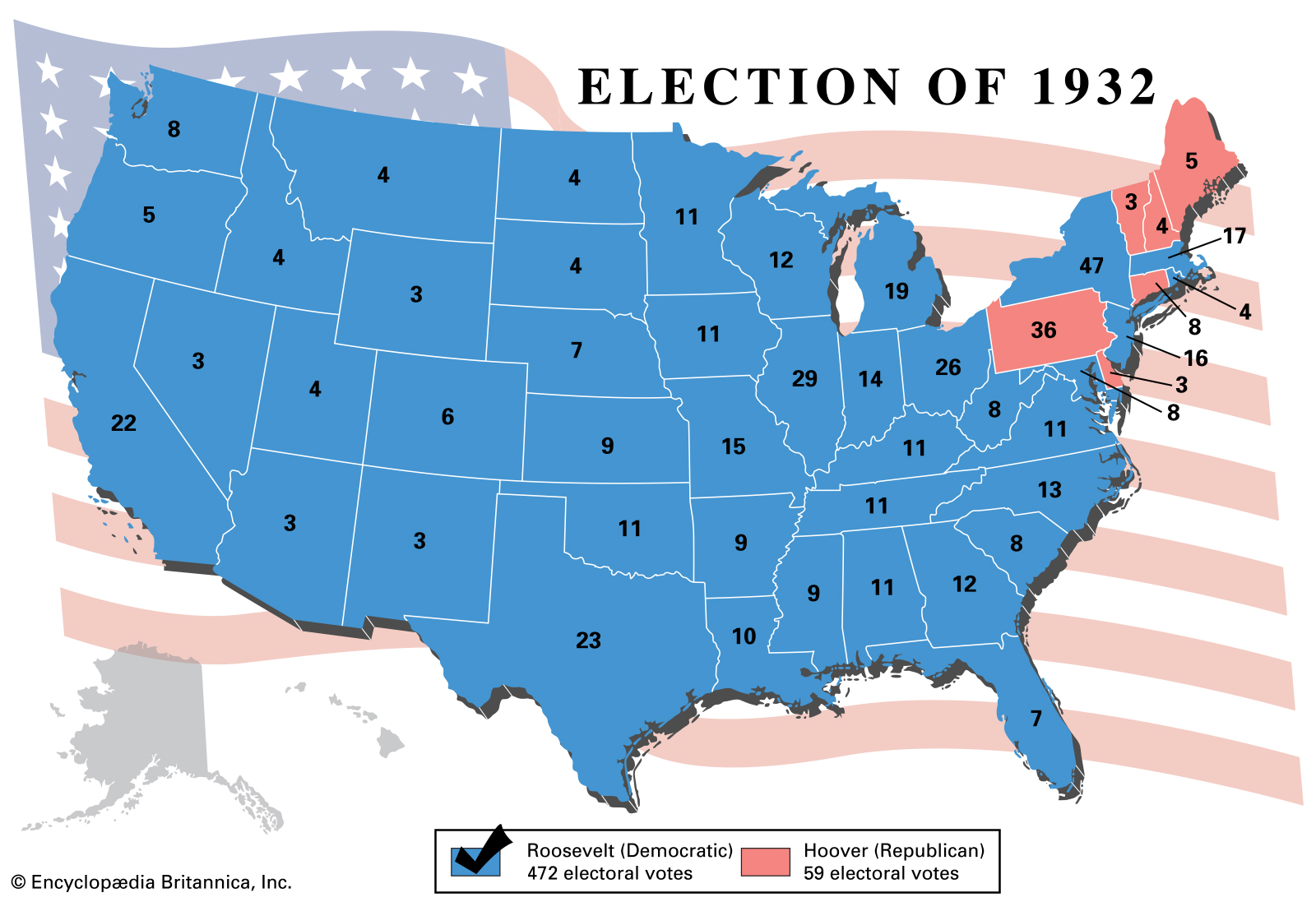
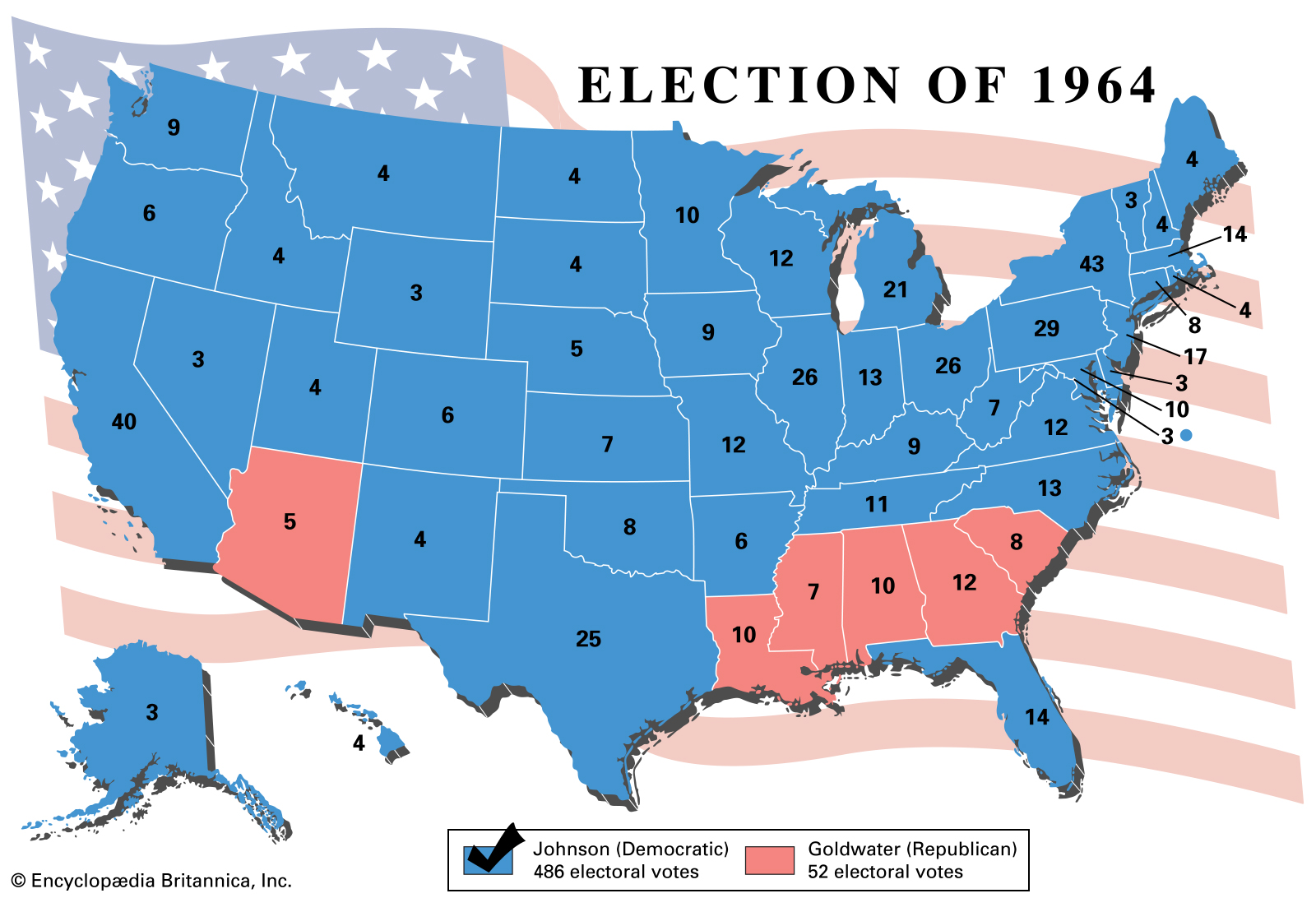
Thus far, contemporary Democrats have hardly mustered simple majorities, as exemplified with the passing of ACA, and more recently even failed to capture the Senate, despite winning the House. History suggests only an overwhelming win would position Democrats to discard the right and coax the middle into passing the more sweeping Sanders-style legislation upon which the party has been increasingly campaigning – universal health care, the Green New Deal, wealth taxation, elimination of Immigration and Customs Enforcement (ICE), etc. Shy of that, however, their promises appear disingenuous.
The most dedicated emotive Democrats can be expected to support their nominees over any Republican candidate but the party will need the support of moderates and independents to win the swing districts and states necessary to secure control of the two elected branches of the federal government – legislative and executive – which would then empower them to select members for the third branch – the judiciary, in effort to help protect their legislation.
Moderates moderate. They tend to balance values like justice and liberty. They can sense fairness and hypocrisy. It is their nature to temper passions and balance perspectives through reasonably consistent application of core principles. When applied to politics, principles supported with rational programs may be acceptable to them, but we should expect them to reject irrational programs based on irrational principles and absolutism, the black/white Us vs. Them mentality. No, not everyone can be convinced through reason, but not everyone can be swayed with emotion either.
Roosevelt and Johnson would have been ill-positioned to pass lasting socialistic policies and programs without their ability to appeal to the middle of the political spectrum. Will today’s political leaders ignore history’s lessons? Will they be able to craft that transformative legislation without unmistakable public support?
(See Part II: Twenty Questions for 2020 Democrats)
[1] Michael A. Cohen, American Maelstrom: The 1968 Election and the Politics of Division, (2016)
[2] Ruy Teixeira and John Haplin, The Return of the Obama Coalition, (Center for American Progress, 2012) https://www.americanprogress.org/issues/democracy/news/2012/11/08/44348/the-return-of-the-obama-coalition/
[3] Timeline: Affordable Care Act, (Affordable Health California, 2020) http://affordablehealthca.com/timeline-obamacare/
[4] Nicholas Bagley, President Obama Flouted Legal Norms to Implement Obamacare. Now Trump May Go Further, (Vox, 2017) https://www.vox.com/the-big-idea/2017/2/1/14463904/obamacare-executive-power-trump-law
[5] Susannah Luthi, Supreme Court Will Hear Major Challenges to Obamacare, (Politico, 2020) https://www.politico.com/news/2020/03/02/supreme-court-obamacare-case-118643
[6] Jonathan Cohn, The ACA, Repeal, and the Politics of Backlash, (Health Affairs, 2020) https://www.healthaffairs.org/do/10.1377/hblog20200305.771008/full/
[7] Victoria McGrane, Trump’s Greatest Mission: Erasing Obama’s Legacy, (Boston Globe, 2017) https://www.bostonglobe.com/news/nation/2017/12/16/trump-greatest-mission-erasing-obama-legacy/OA9M4qwS2hHlOj3MGLxGxK/story.html
 The Offence
6 thoughts on “Beware the Narrative, Nixon Was Reelected”